Computer Graphics Forum 2023, 42(6) · Wiley (SCIE)
ROI Scissor: Interactive Segmentation of Feature Region of Interest in a Triangular Mesh
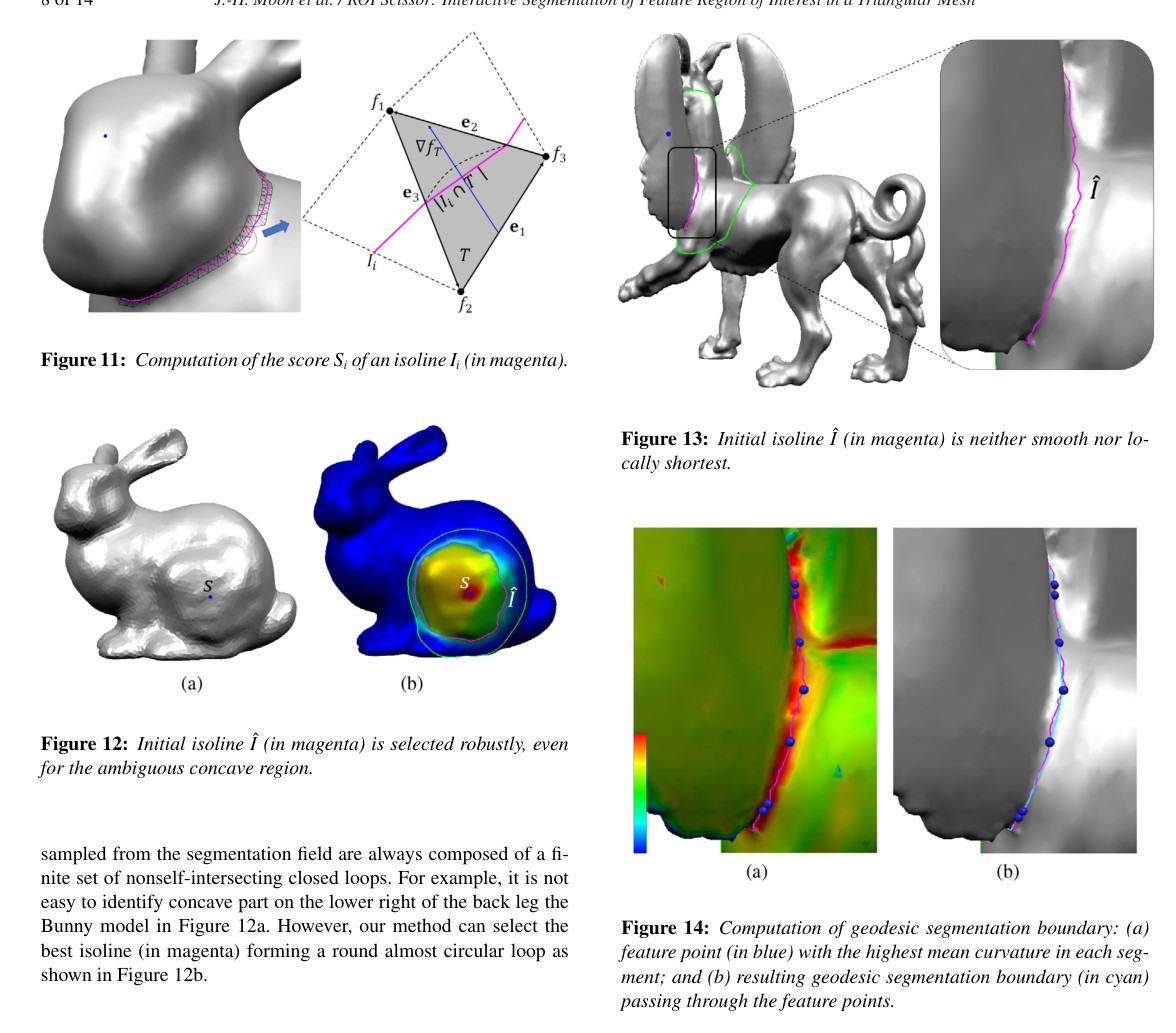
A simple and effective method for interactively segmenting feature regions in a triangular mesh with a single mouse click. A concavity-aware harmonic field is computed on a geodesic disc candidate region, from which an initial isoline is selected. Feature points on the isoline drive anisotropic geodesics that form the final smooth, locally shortest segmentation boundary—consistent regardless of where within the ROI the user clicks.
Computers & Graphics 2019, 81: 61–72 · Elsevier (SCIE)
Fast and Robust Computation of the Hausdorff Distance Between Triangle Mesh and Quad Mesh for Near-Zero Cases
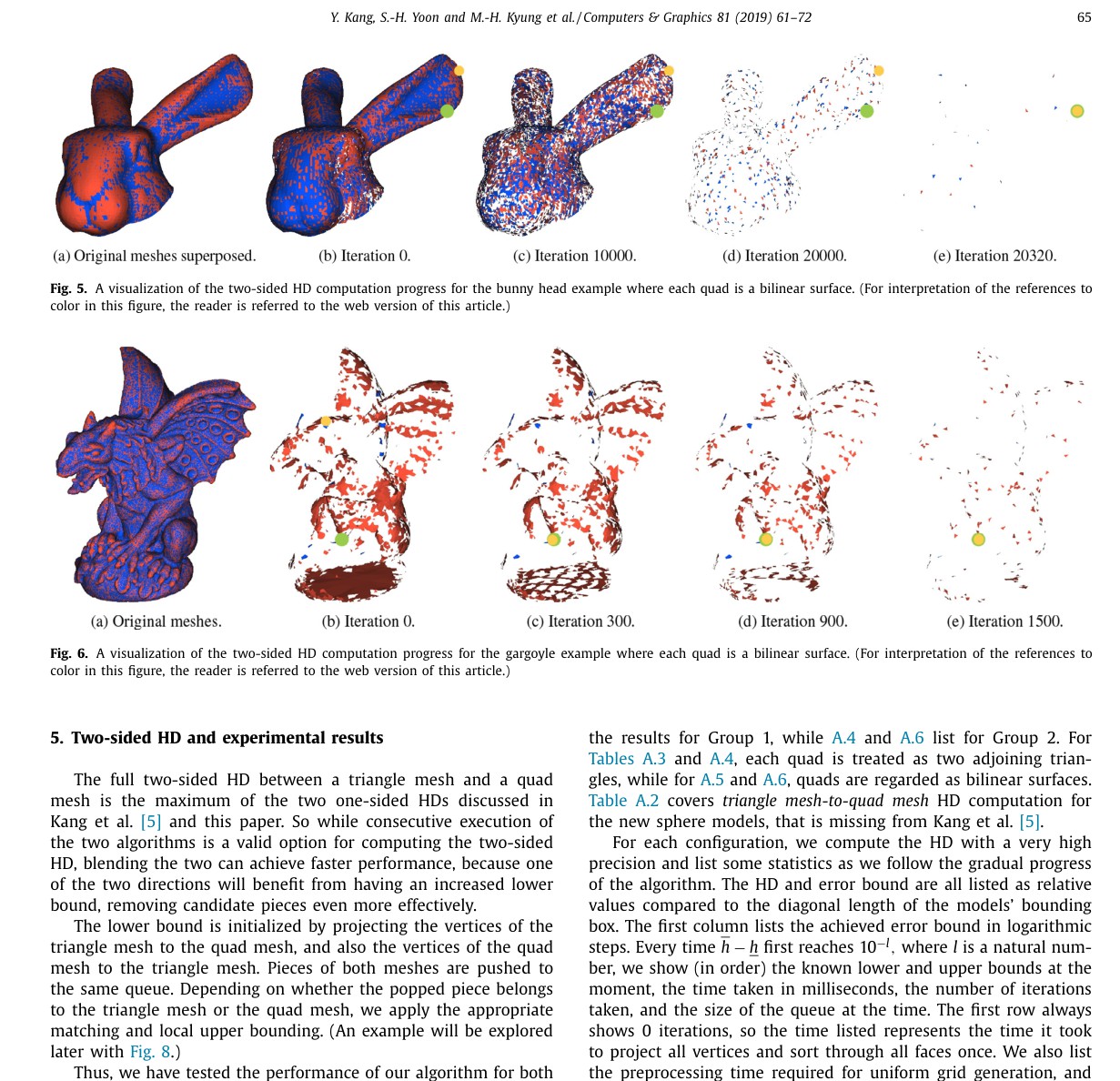
An algorithm for computing the two-sided Hausdorff distance between a triangle mesh and a quad mesh, guaranteed within a given error bound down to machine precision. The algorithm extends a prior one-sided method by completing the opposite direction (quad-to-triangle) via splitting each quad into two triangles and introducing new matching methods. Experimental results demonstrate interactive-speed computation even for near-zero Hausdorff distance cases.
The Visual Computer 2019, 35(3) · Springer (SCIE)
Minkowski Sum Computation for Planar Freeform Geometric Models using G¹-Biarc Approximation and Interior Disk Culling
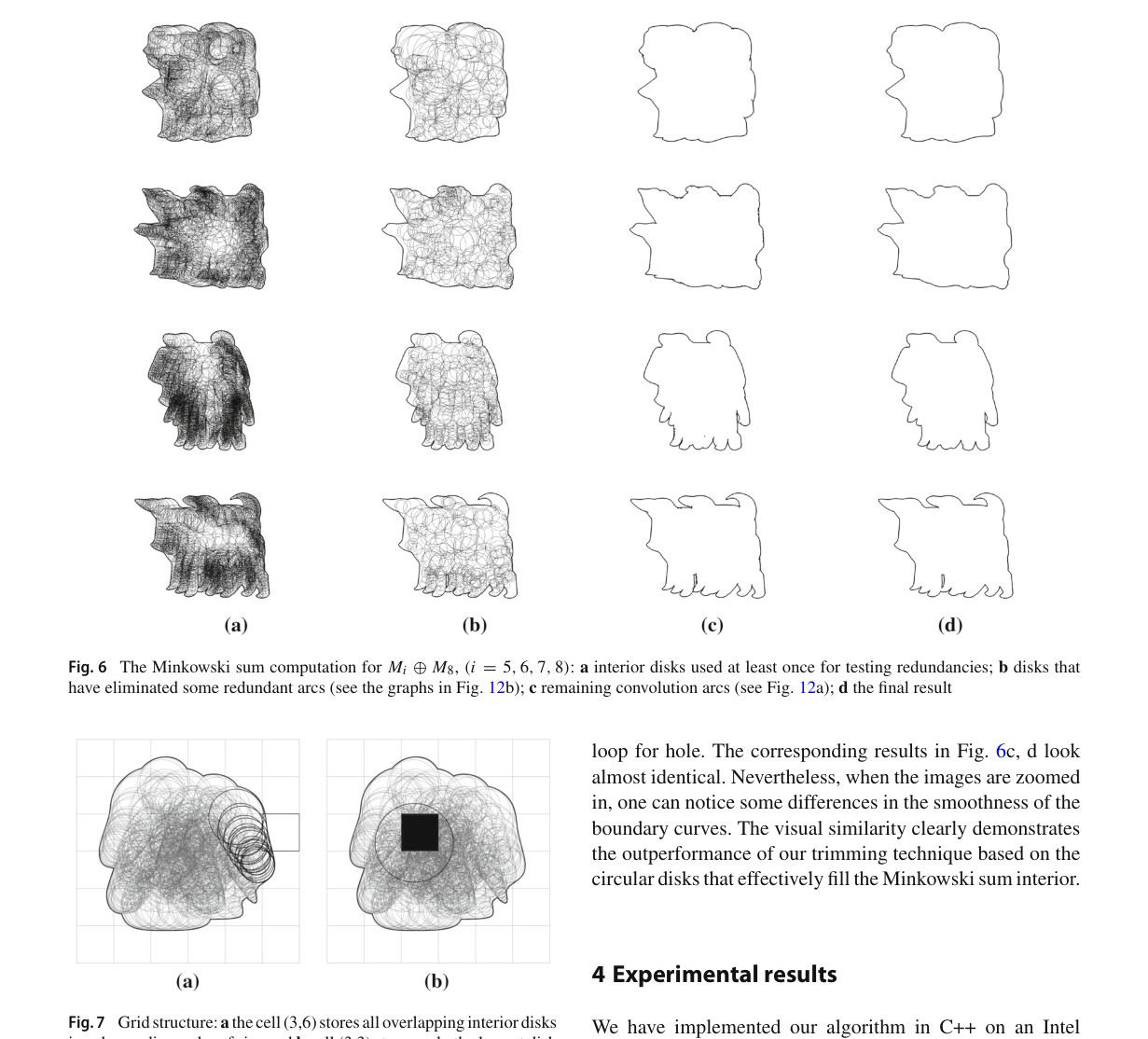
A robust and efficient Minkowski sum algorithm for planar freeform geometric models. Input boundary curves are approximated by G¹-biarc splines, enabling exact convolution arc computation. Interior disk culling trims redundant convolution arcs using a grid-based structure of interior disks, dramatically reducing the number of candidate arcs and improving overall efficiency compared to prior methods.
Computer Aided Geometric Design 2018, 62: 91–103 · Elsevier (SCI) Best Paper Award
Fast and Robust Hausdorff Distance Computation from Triangle Mesh to Quad Mesh in Near-Zero Cases
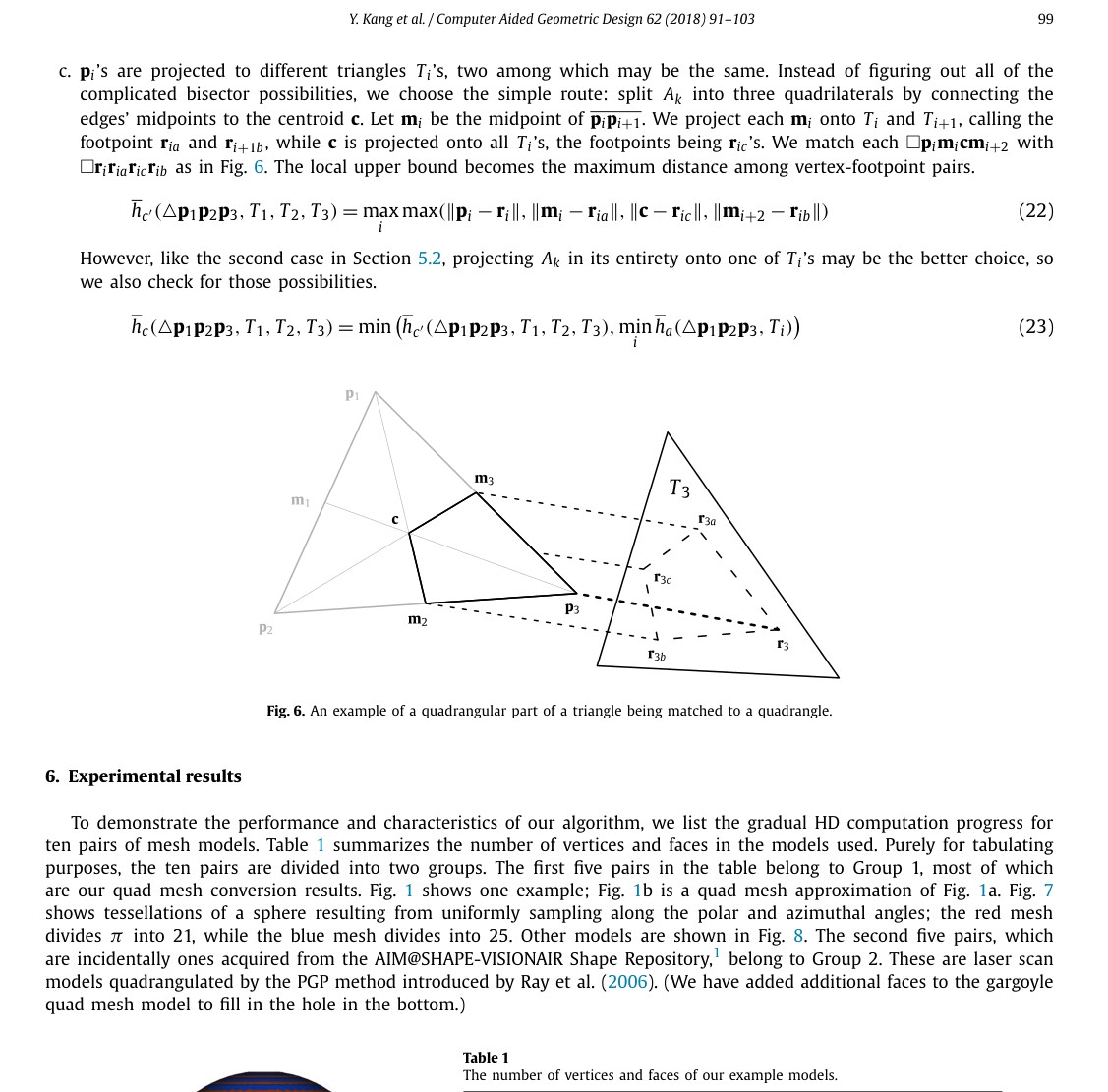
An algorithm that computes the one-sided Hausdorff distance from a triangle mesh to a quad mesh with high robustness and low memory consumption. The algorithm avoids storing combinatorial pairs by using point projection via uniform grid, while achieving much higher precision than previous methods. Experimental results show that even near-zero Hausdorff distance cases are handled at interactive speed with manageable memory usage.

IEEE Computer Graphics and Applications 2017, 37(6): 65–75 · IEEE (SCI)
Blending Face Details: Synthesizing a Face Using Multiscale Face Models
We present a system for creating realistic 3D face models by blending multi-scale facial details. The approach allows artists to intuitively design face models by parameterizing the problem in a way that is understandable and controllable. The system synthesizes faces by combining coarse shape with fine-scale details such as wrinkles and pores, leveraging multiscale displacement representations that enable flexible and artist-friendly face design for games and animated films.
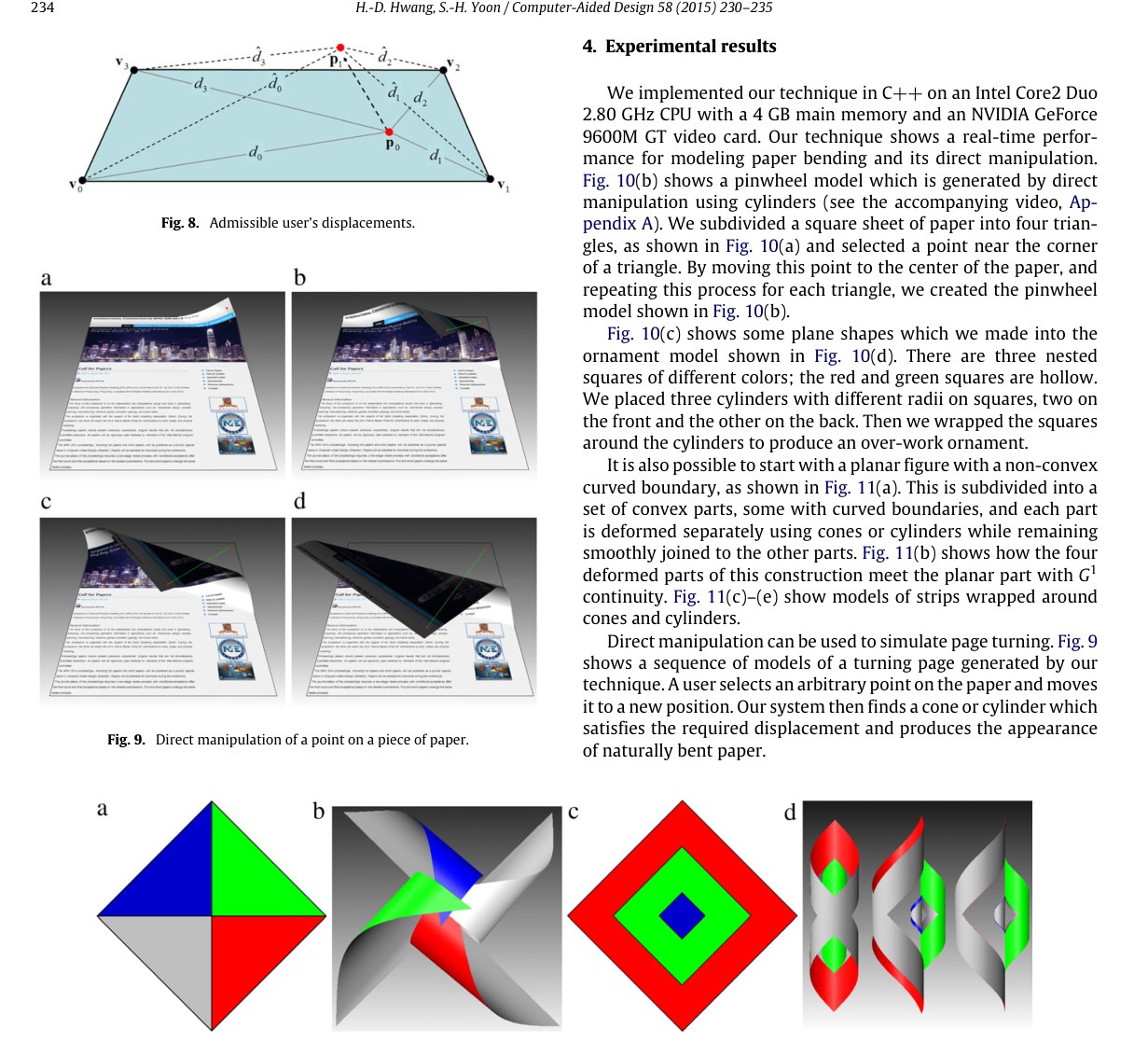
Computer-Aided Design 2015, 58(c): 230–235 · Elsevier (SCI)
Constructing Developable Surfaces by Wrapping Cones and Cylinders
We model developable surfaces by wrapping a planar figure around cones and cylinders. Complicated developables can be constructed by successive mappings using cones and cylinders of different sizes and shapes. We also propose an intuitive control mechanism, which allows a user to select an arbitrary point on the planar figure and move it to a new position. Numerical techniques are then used to find a cone or cylinder that produces the required mapping. Several examples demonstrate the effectiveness of our technique.
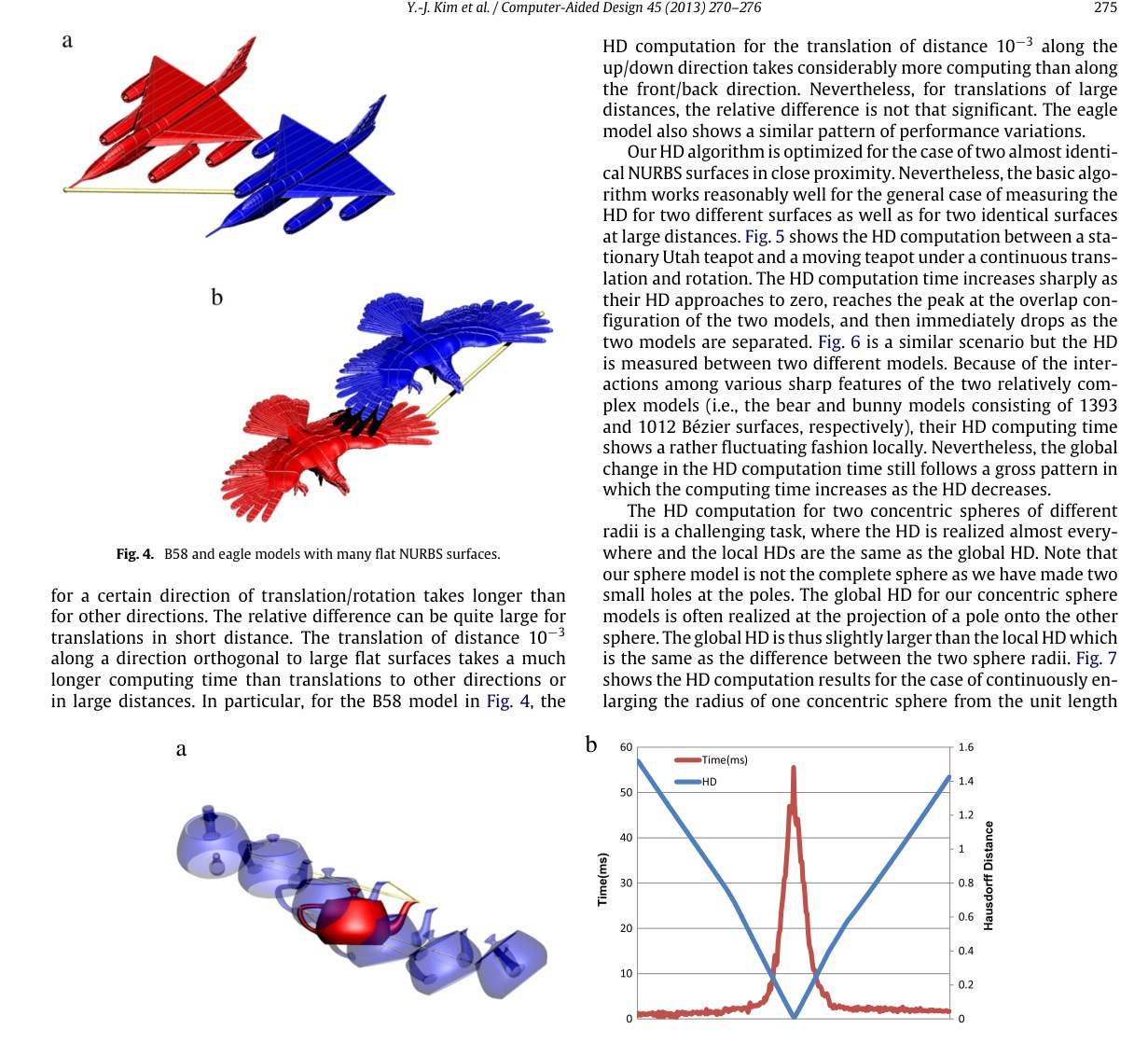
Computer-Aided Design 2013, 45(2): 270–276 · Elsevier (SCI)
Efficient Hausdorff Distance Computation for Freeform Geometric Models in Close Proximity
We present an interactive-speed algorithm for computing the Hausdorff Distance between two freeform geometric models represented with NURBS surfaces. The algorithm is based on an effective technique for matching a surface patch from one model to the corresponding nearby surface patch on the other model, employing a bounding volume hierarchy of Coons patches. By comparing local HD upper bounds against a global HD lower bound, we eliminate the majority of redundant surface patches from further consideration.
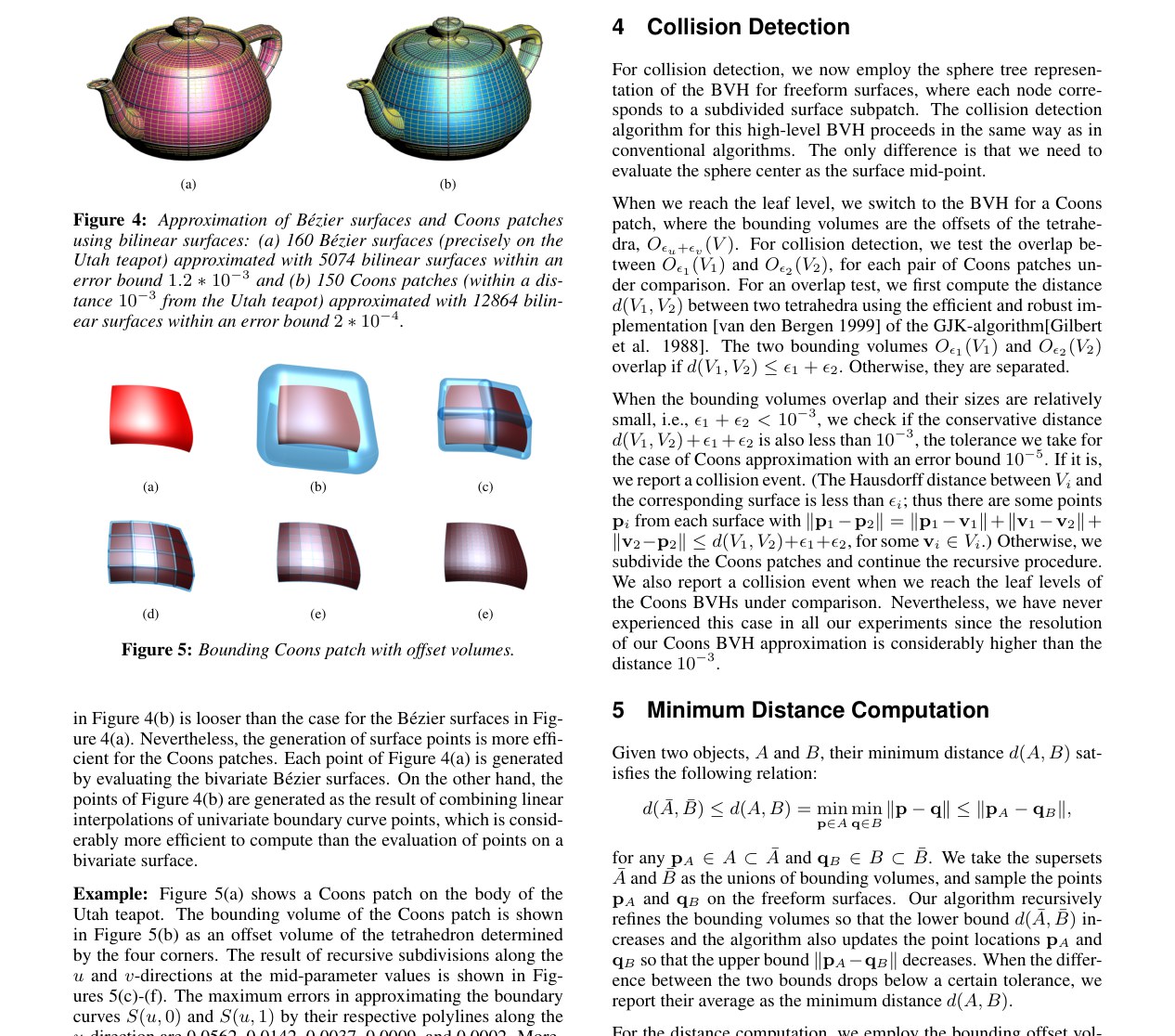
ACM Transactions on Graphics 2011, 30(6): Article 169 · ACM (SCI)
Coons BVH for Freeform Geometric Models
We present a bounding volume hierarchy (BVH) for freeform NURBS surfaces, using Coons patches and bilinear surfaces as the bounding volumes. The hierarchy provides an efficient approximation of NURBS surfaces within a given error bound. This BVH facilitates a wide range of geometric operations including collision detection, minimum distance computation, and Hausdorff distance computation for complex freeform models at interactive speeds.
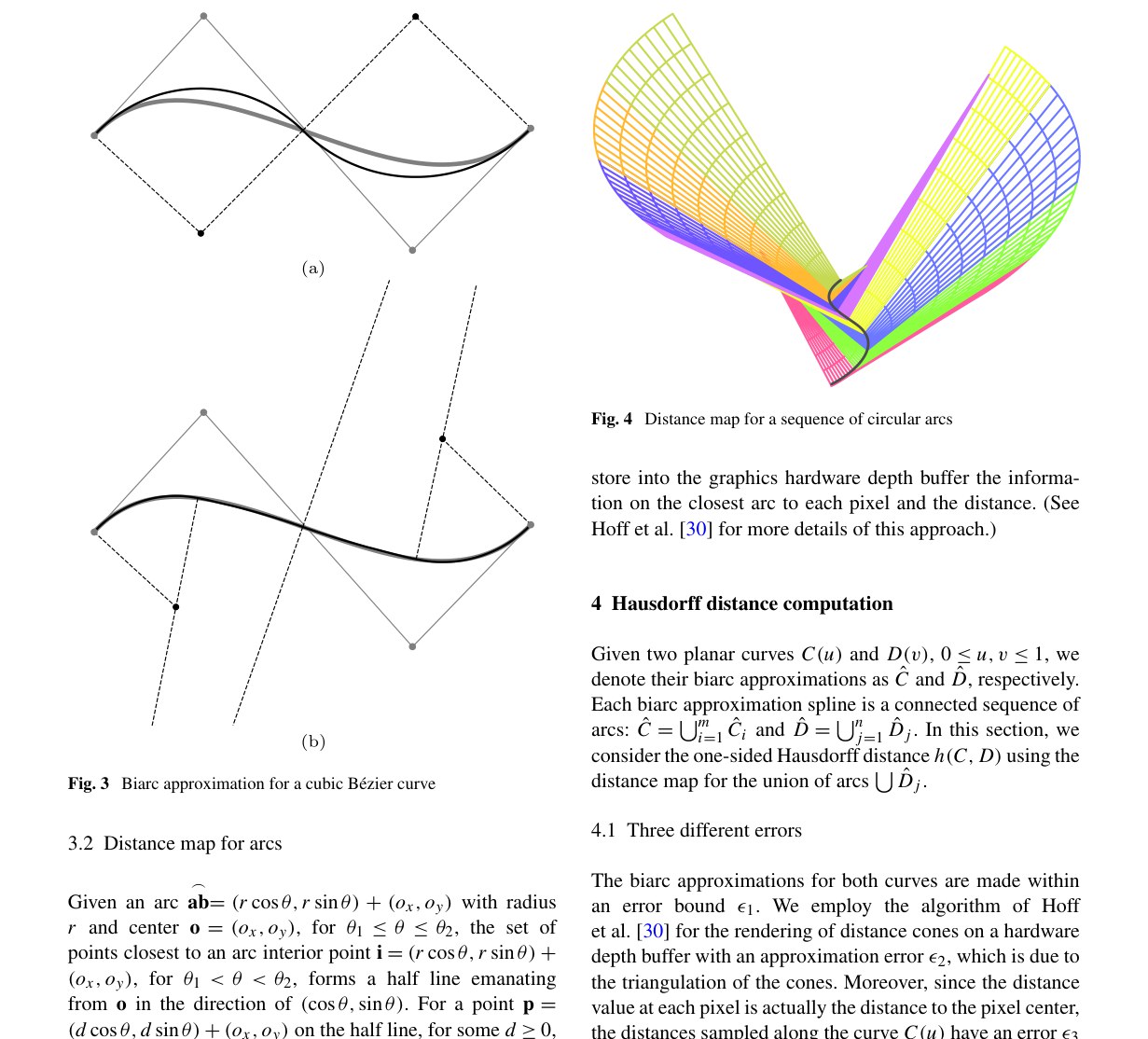
The Visual Computer 2010, 26(6–8): 1007–1016 · Springer (SCIE)
Precise Hausdorff Distance Computation for Planar Freeform Curves using Biarcs and Depth Buffer
We present a real-time algorithm for computing the precise Hausdorff Distance between two planar freeform curves. The algorithm approximates each curve with a sequence of G1 biarcs within an arbitrary error bound. The distance map for the union of arcs is rendered efficiently to the graphics hardware depth buffer. By sampling the distance map along the other curve, we estimate a lower bound for the HD and eliminate many redundant curve segments, reducing computation to considerably smaller subproblems solved with a multivariate equation solver.
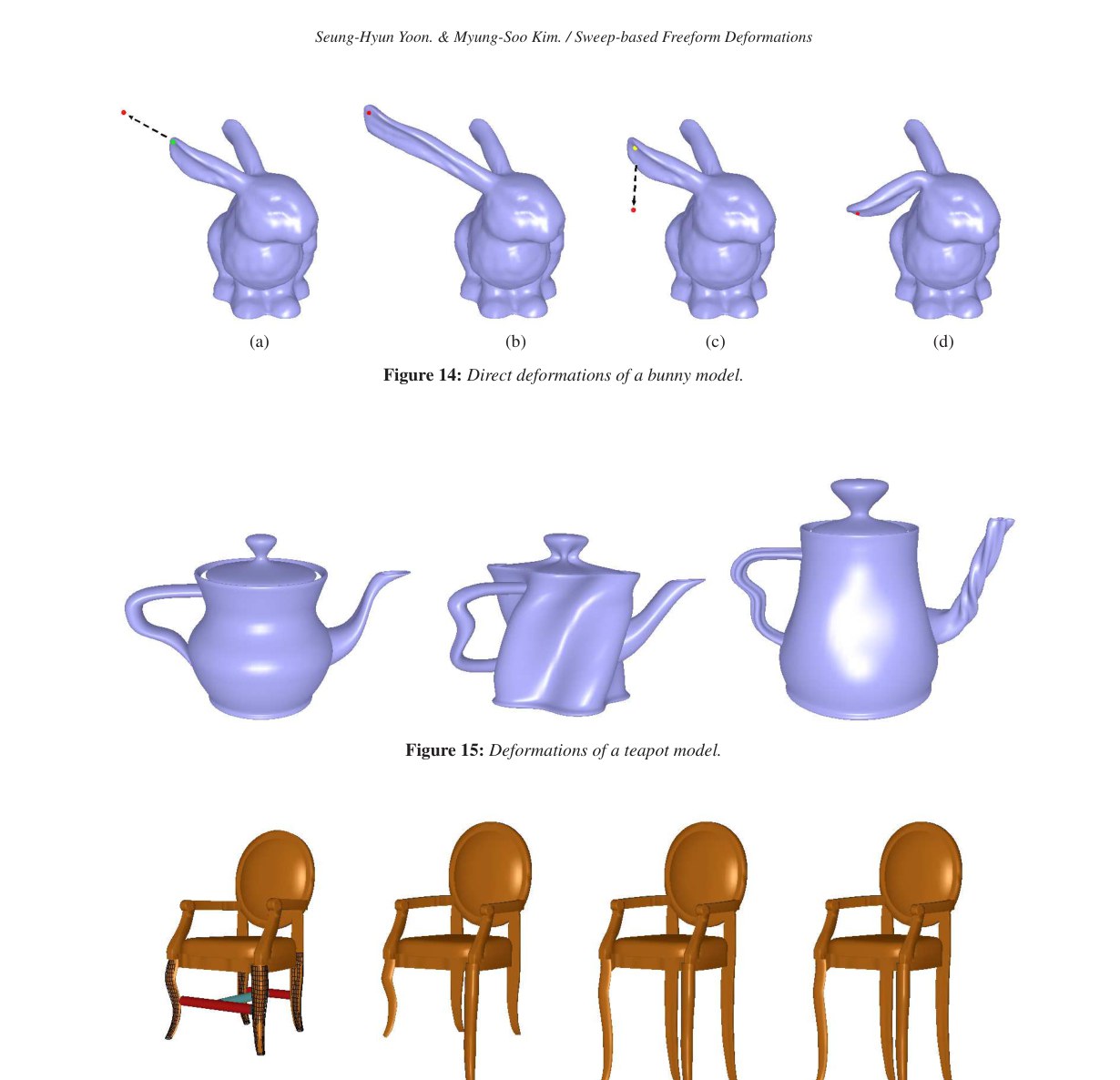
Computer Graphics Forum 2006, 25(3): 487–496 · Wiley / Eurographics (SCIE)
Sweep-based Freeform Deformations
We propose a sweep-based approach to the freeform deformation of three-dimensional objects. Instead of using a volume enclosing the whole object, we approximate only its deformable parts using sweep surfaces. The vertices on the object boundary are bound to the sweep surfaces and follow their deformation. Several sweep surfaces can be organized into a hierarchy so that they interact with each other in a controlled manner, supporting intuitively plausible shape deformation of objects of arbitrary topology with multiple control handles, along with volume preservation.
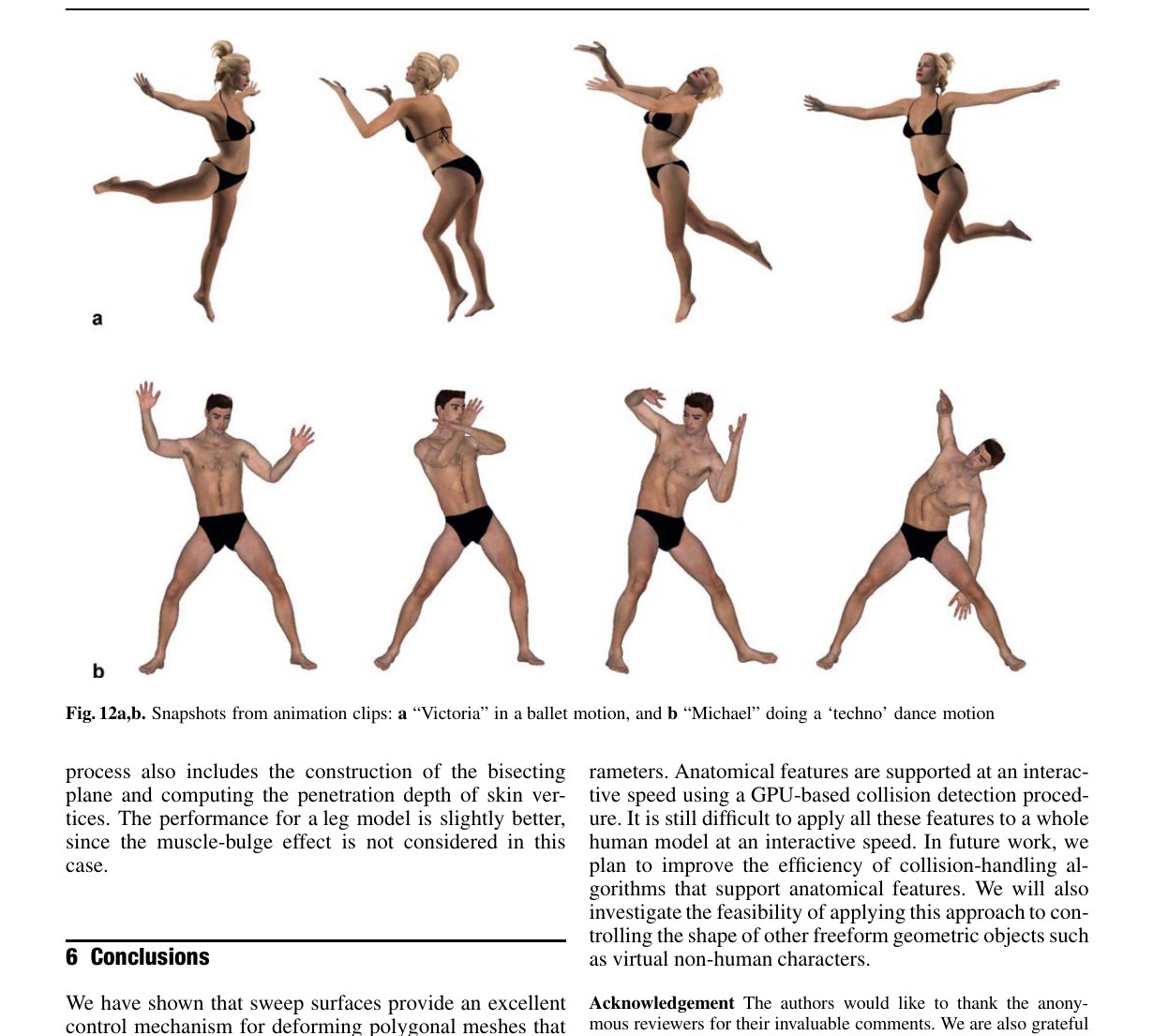
The Visual Computer 2005, 21(8–10): 542–550 · Springer (SCIE)
Sweep-based Human Deformation
We present a sweep-based approach to human body modeling and deformation. A rigid 3D human model, given as a polygonal mesh, is approximated with control sweep surfaces. The vertices on the mesh are bound to nearby sweep surfaces and follow the deformation as the model bends and twists its arms, legs, spine and neck. Anatomical features including bone-protrusion, muscle-bulge, and skin-folding are supported by a GPU-based collision detection procedure. The volumes of arms, legs, and torso are kept constant using a volume integral formula for sweep surfaces.
[2026]
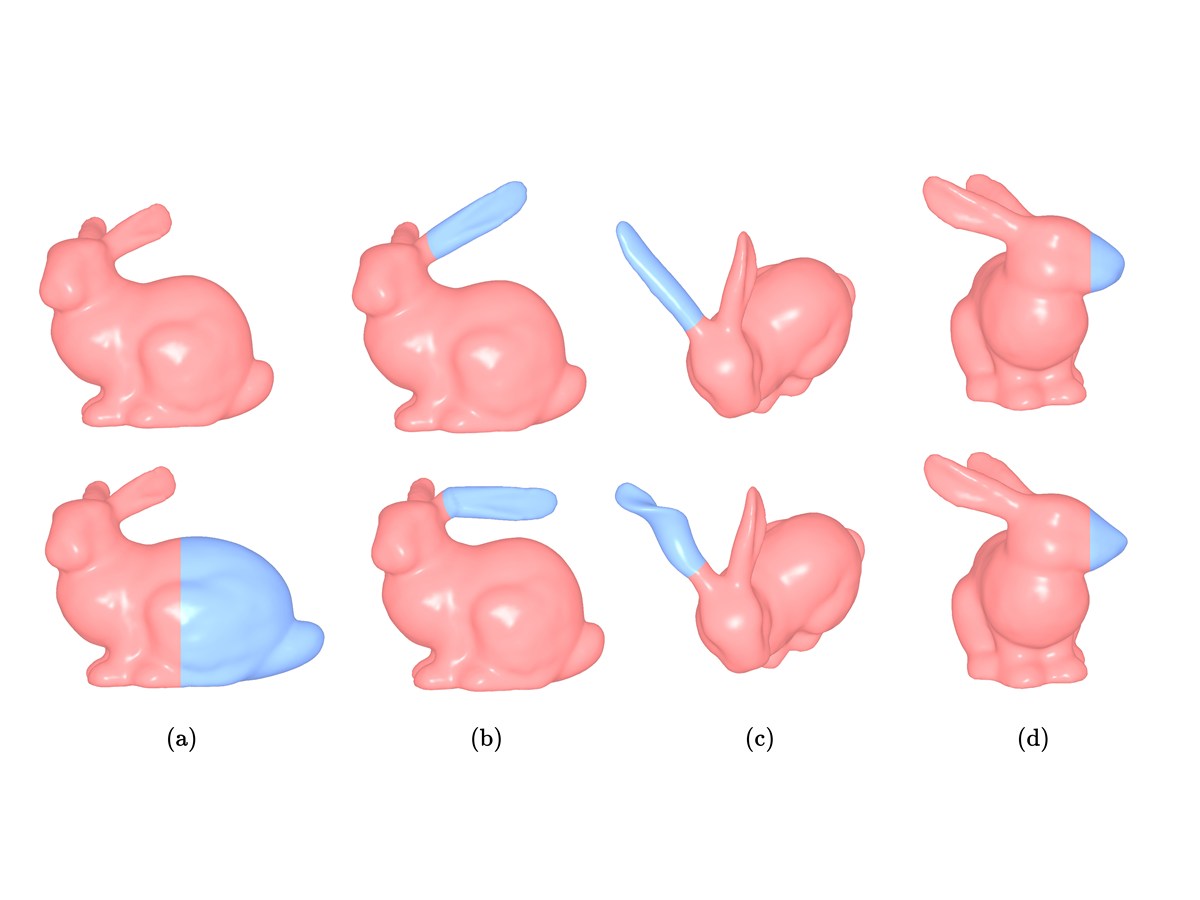
IEEE Access 2026, Vol. 14 (In Press) · IEEE (SCIE)
A Unified Framework for Signed Distance Field Deformations via Inverse Mapping
A unified framework for real-time deformation of three-dimensional Signed Distance Fields (SDFs). A local editing technique coupled with an inverse transformation pipeline traces each query point back to its pre-image in the original field, while a per-point compositing rule confines the deformation to the selected Region of Interest. The deformed field is efficiently reconstructed with the Fast Sweeping Method to restore the Eikonal condition, and an iterative smooth weighting function compensates for deformation-induced volume changes. Integration with a GPU-accelerated ray-marching renderer provides immediate visual feedback during editing.
[2025]
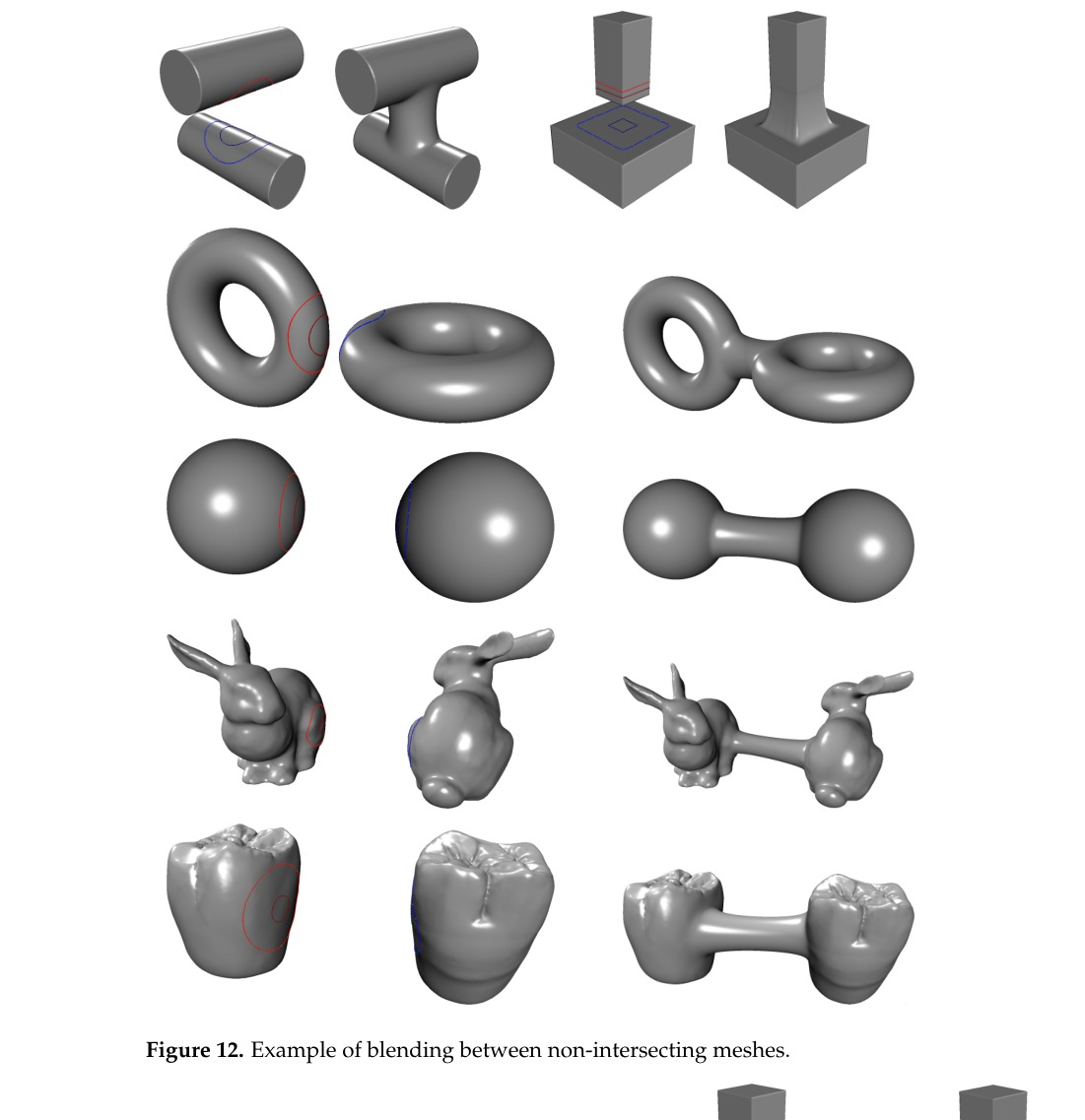
Mathematics 2025, 13(19), 3184 · MDPI (SCIE)
Parametric Blending with Geodesic Curves on Triangular Meshes
An effective method for generating blending meshes by leveraging geodesic curves on triangular meshes. Blending regions are automatically initialized using either minimum-distance points or intersection curves depending on whether the input meshes intersect. Each region is parameterized via geodesic linear interpolation and a reparameterization strategy establishes optimal curve correspondences, ensuring smooth, twist-free connections.
Symmetry 2025, 17(10), 1727 · MDPI (SCIE)
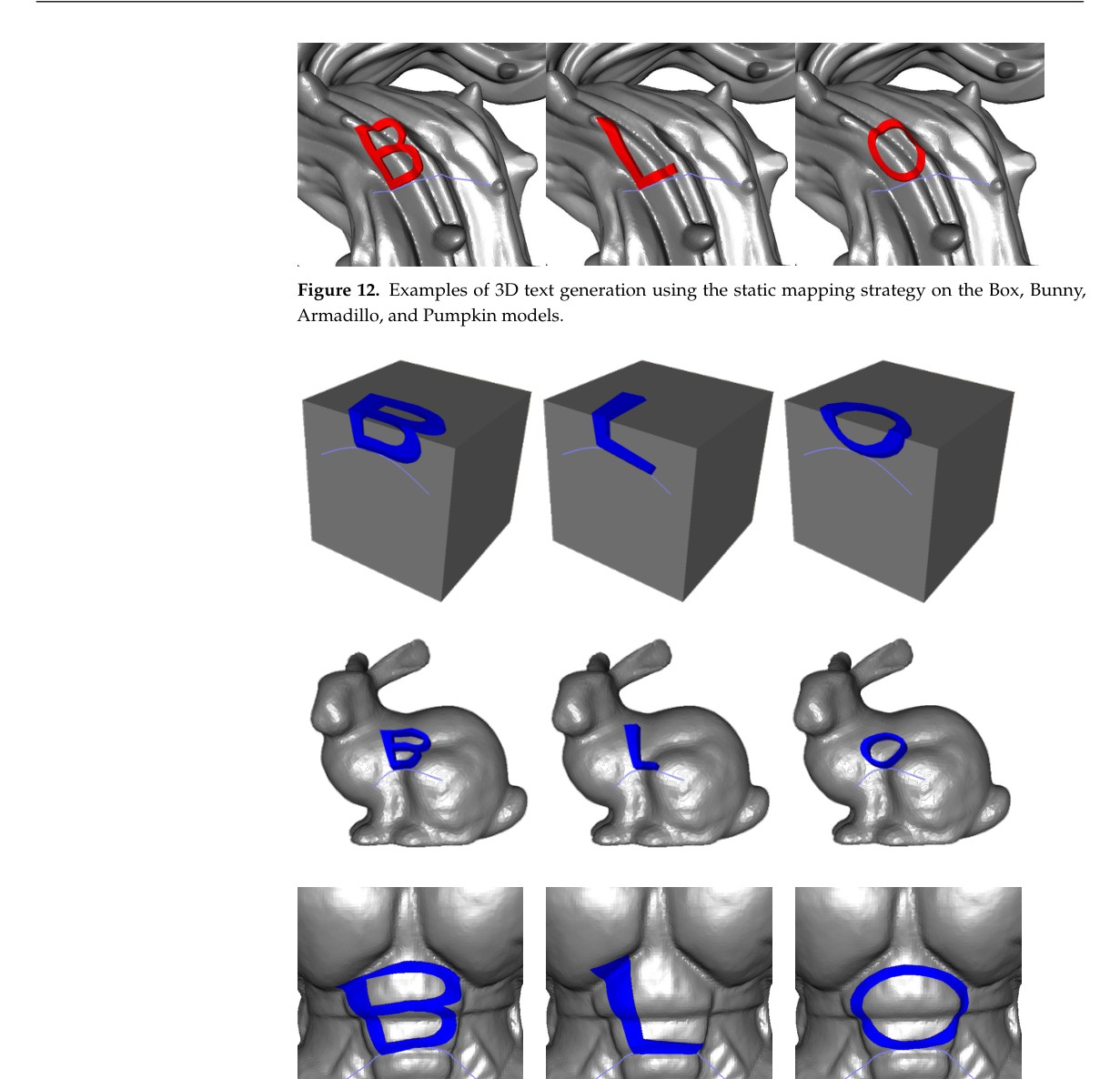
GeoText: Geodesic-Based 3D Text Generation on Triangular Meshes
A framework for generating 3D text directly on triangular meshes while faithfully preserving local surface geometry. TrueType Font outlines are mapped onto the mesh along a user-specified placement curve and reconstructed using geodesic Bézier curves. Two mapping strategies based on local tangent frames and straightest geodesics ensure natural font alignment, enabling embossing, engraving, or independent 3D text meshes without self-intersections.
[2024]
IEEE Access 2024, 12: 197035–197047 · IEEE (SCIE)
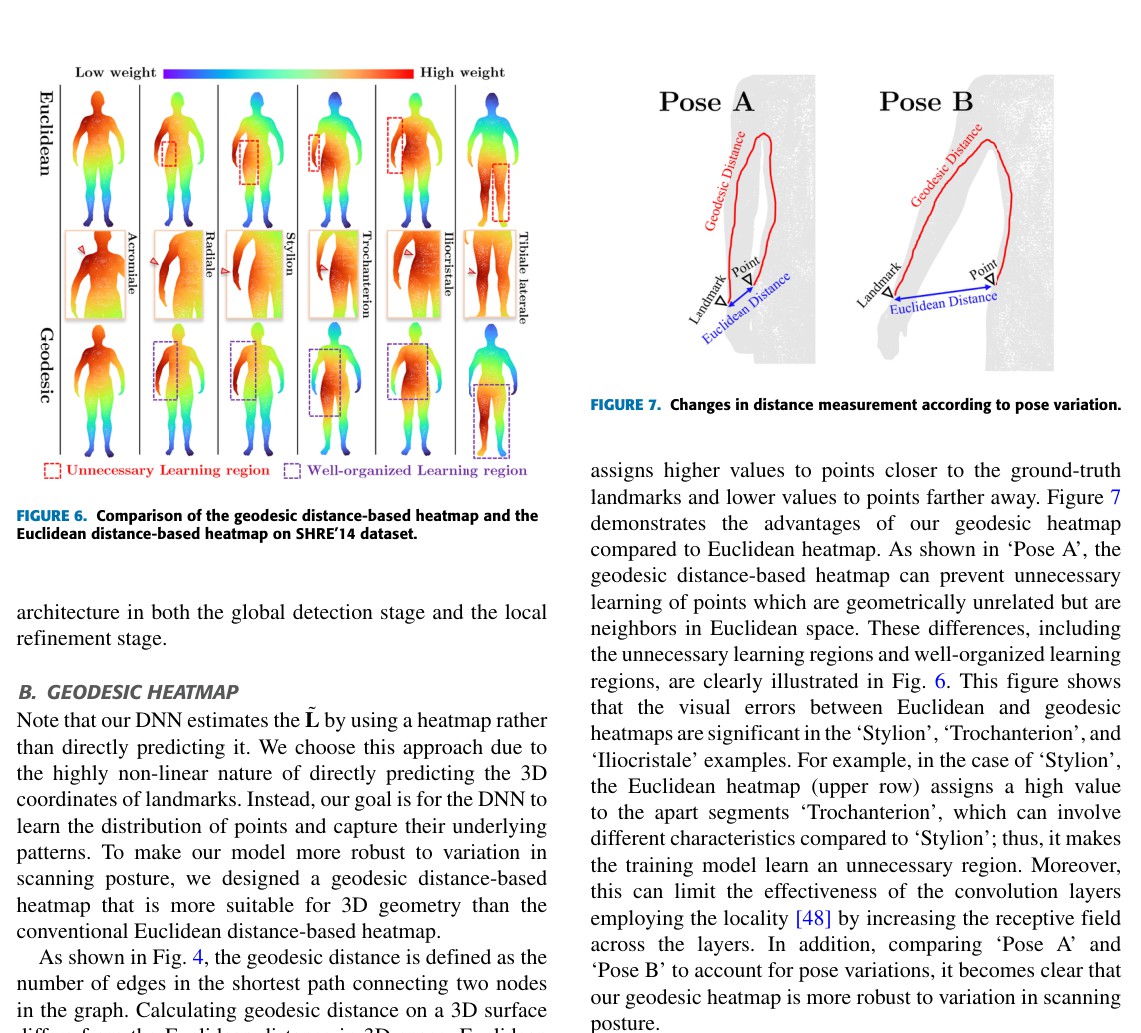
Anthropometric Landmark Detection Network via Geodesic Heatmap on 3D Human Scan
A deep learning method for automatic anthropometric landmark extraction from 3D human scans using a coarse-to-fine strategy. A novel geodesic distance-based heatmap effectively captures point distributions on 3D shapes even with pose variations. The method achieves the lowest average detection error on the SHREC'14 dataset with a maximum error reduction of 76.14%, and requires no predefined templates or handcrafted features.
Mathematics 2024, 12(10), 1432 · MDPI (SCIE)
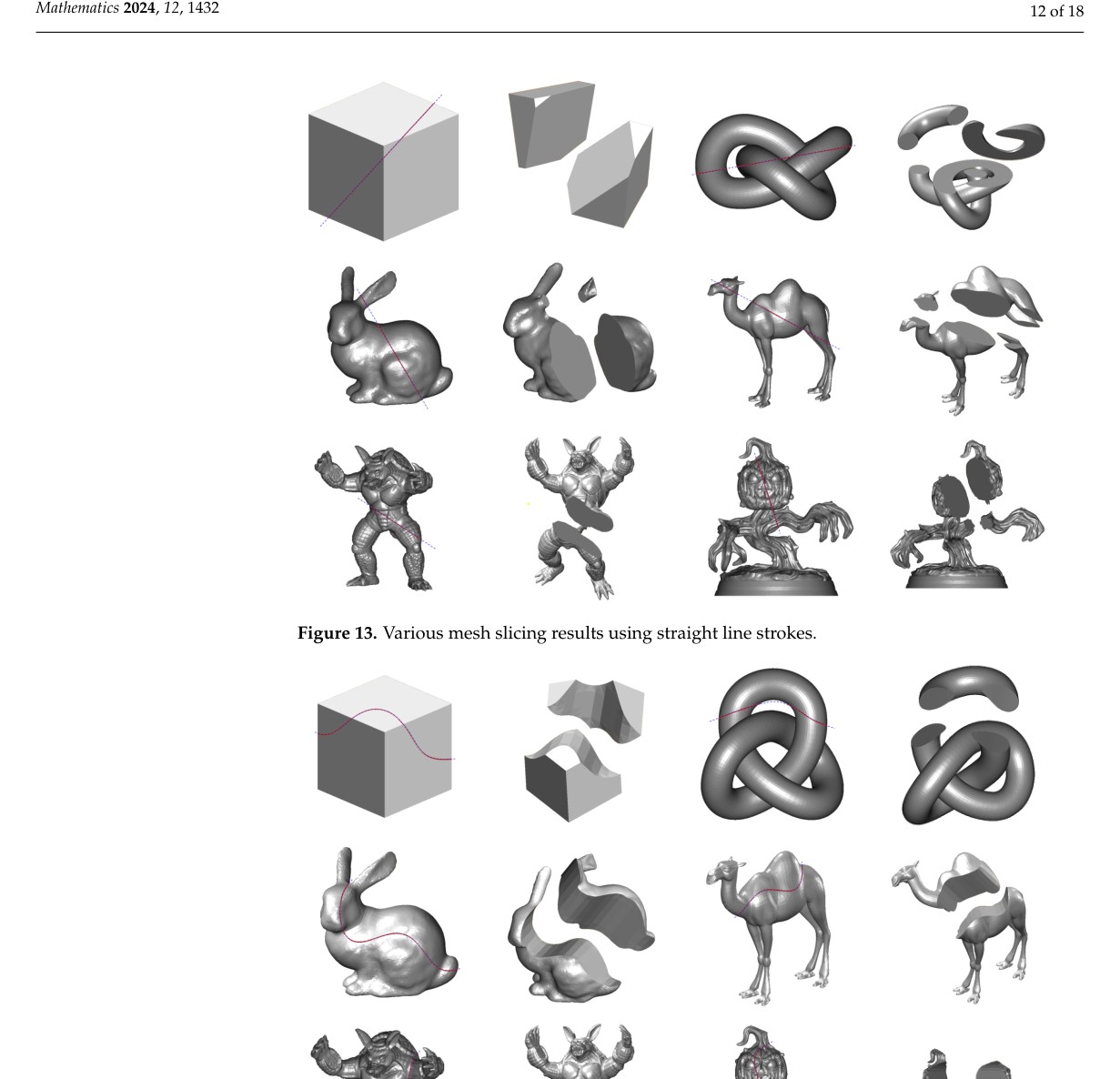
An Effective Method for Slicing Triangle Meshes Using a Freeform Curve
A novel approach for freely slicing triangle meshes using a freeform curve without discretizing it into line segments. The user draws a stroke defining the cutting trajectory, which is extended into a ruled surface. Intersections are computed efficiently by decomposing the Line–Surface Intersection problem into Plane–Curve and Line–Line subproblems, enabling arbitrary straight and curved slicing while preserving efficiency and accuracy.
[2023]
IEEE Access 2023, 11: 112175–112188 · IEEE (SCIE)
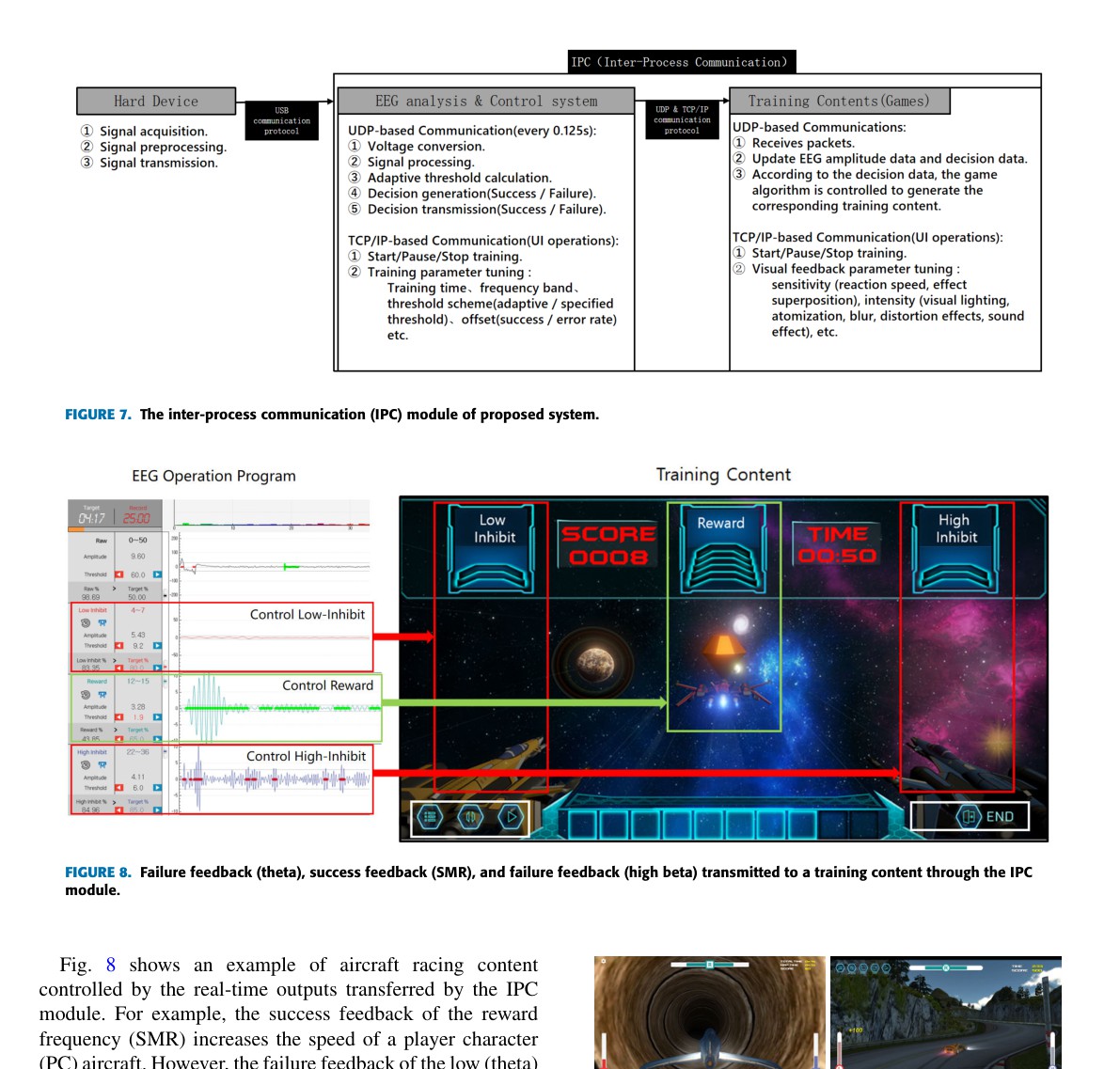
Effective Neurofeedback Training of Large Electroencephalogram Signals Using Serious Video Games
An effective neurofeedback system for treating neuropsychiatric disorders in children through EEG signal processing and auto-thresholding. The system determines optimal threshold values using numerical optimization to achieve a target success rate, generating success/failure feedback for reward and inhibit EEG frequencies. Training content is implemented as serious video games, making neurofeedback training engaging and clinically effective without relying solely on therapist experience.
Computer Graphics Forum 2023, 42(6) · Wiley (SCIE)
ROI Scissor: Interactive Segmentation of Feature Region of Interest in a Triangular Mesh
A simple and effective method for interactively segmenting feature regions in a triangular mesh with a single mouse click. A concavity-aware harmonic field is computed on a geodesic disc candidate region, from which an initial isoline is selected. Feature points on the isoline drive anisotropic geodesics that form the final smooth, locally shortest segmentation boundary—consistent regardless of where within the ROI the user clicks.
[2022]
Mathematics 2022, 10(3), 500 · MDPI (SCIE)
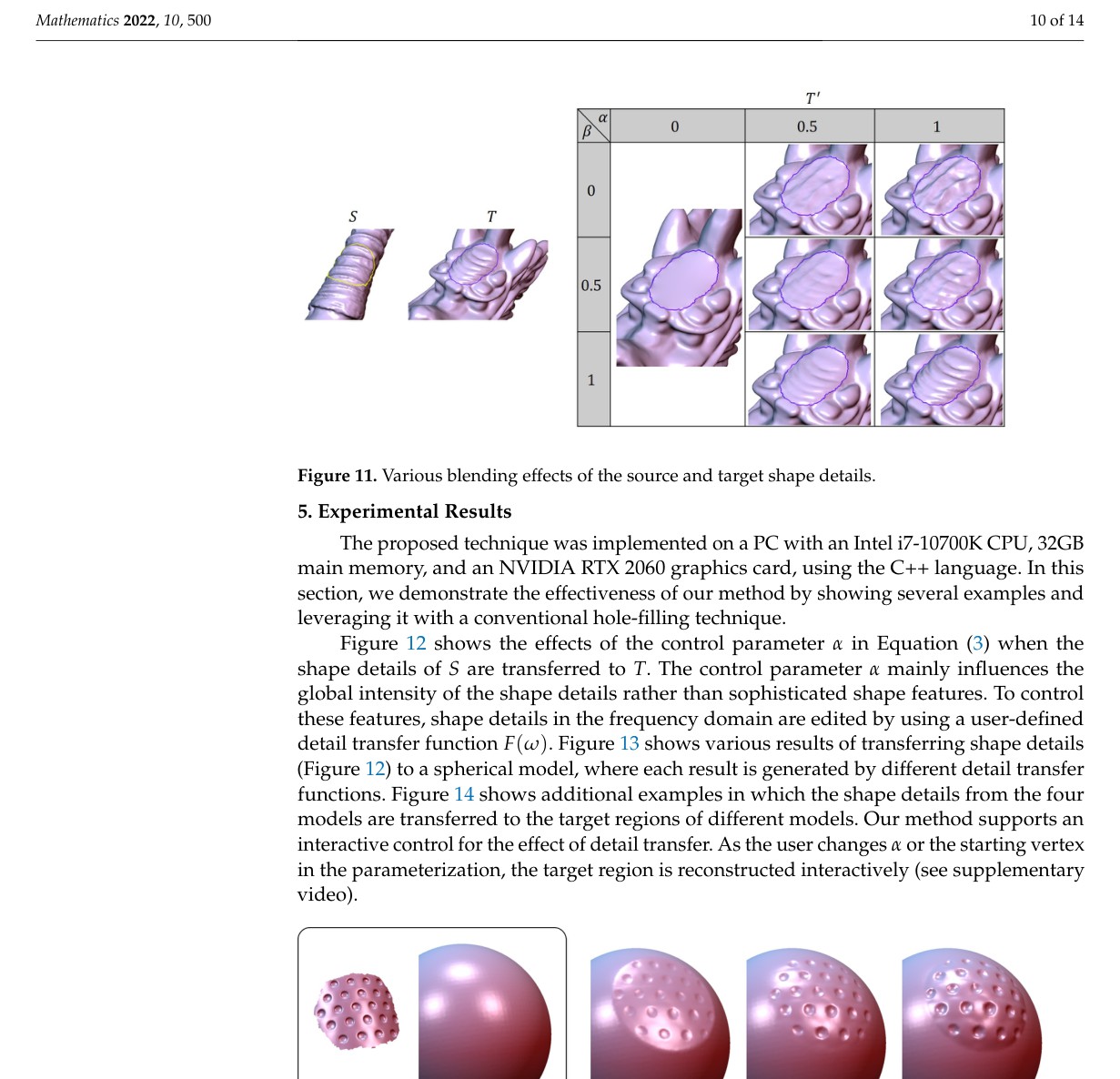
GeoStamp: Detail Transfer Based on Mean Curvature Field
A simple and effective method for transferring shape details between mesh regions using a Poisson equation. The mean curvature field of a source region, computed via the Laplace–Beltrami operator, is defined as its geometric detail. Source and target regions are co-parameterized on a 2D domain, the curvature field is interpolated by correspondence, and the Poisson equation is solved to replace the target's curvature field with that of the source.
[2021]
Symmetry 2021, 13(10), 1936 · MDPI (SCIE)
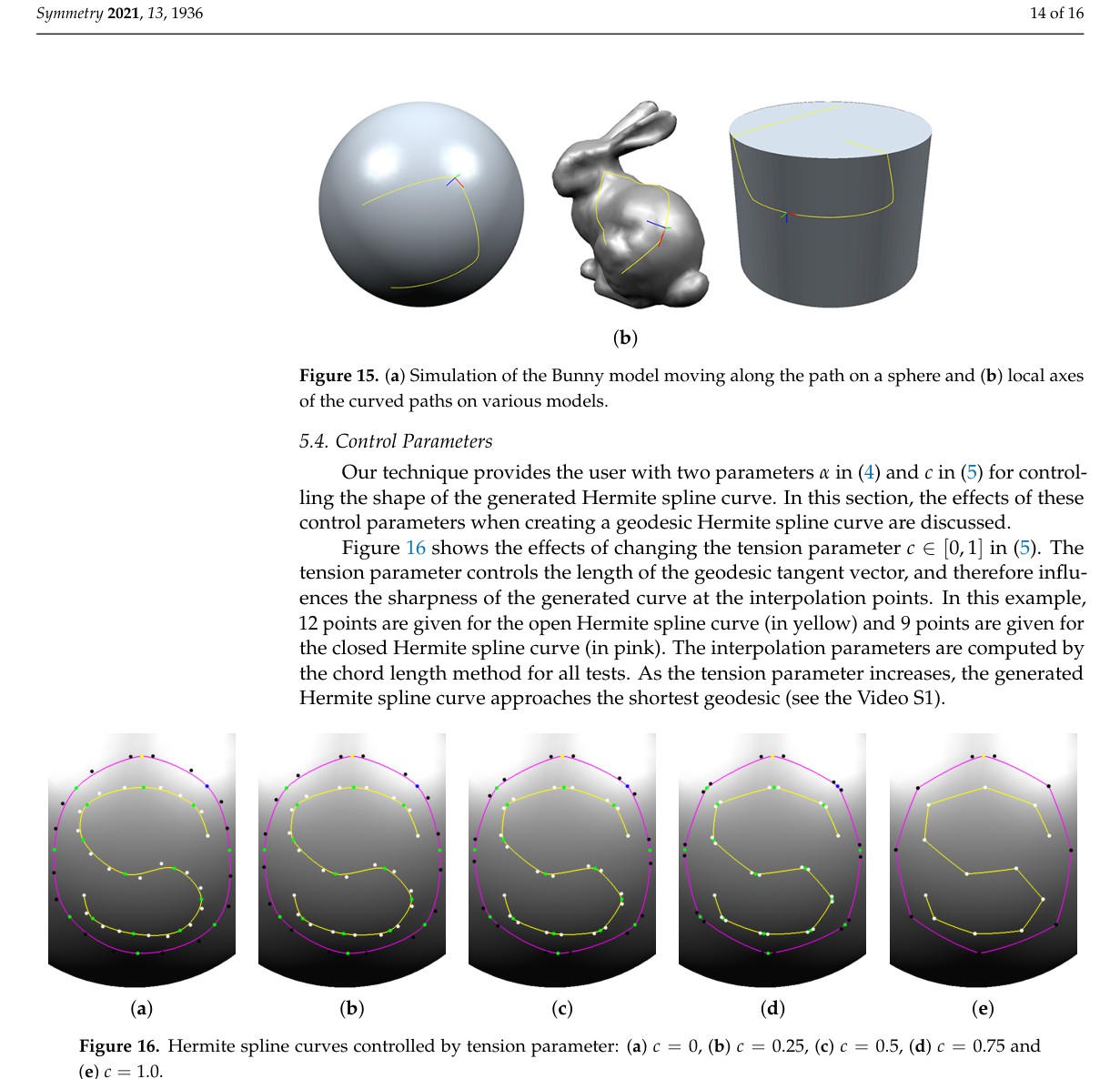
Geodesic Hermite Spline Curve on Triangular Meshes
An effective method for constructing C¹ piecewise cubic curves on a triangular mesh by interpolating given mesh points. Hermite interpolation is extended to meshes by defining geodesic vectors as straightest geodesics and devising geodesic operations for points and vectors. The resulting geodesic Hermite spline lies on the mesh surface and supports applications including mesh cutting and segmentation, with control parameters for curve sharpness.
[2020]
Symmetry 2020, 12(11), 1759 · MDPI (SCIE)
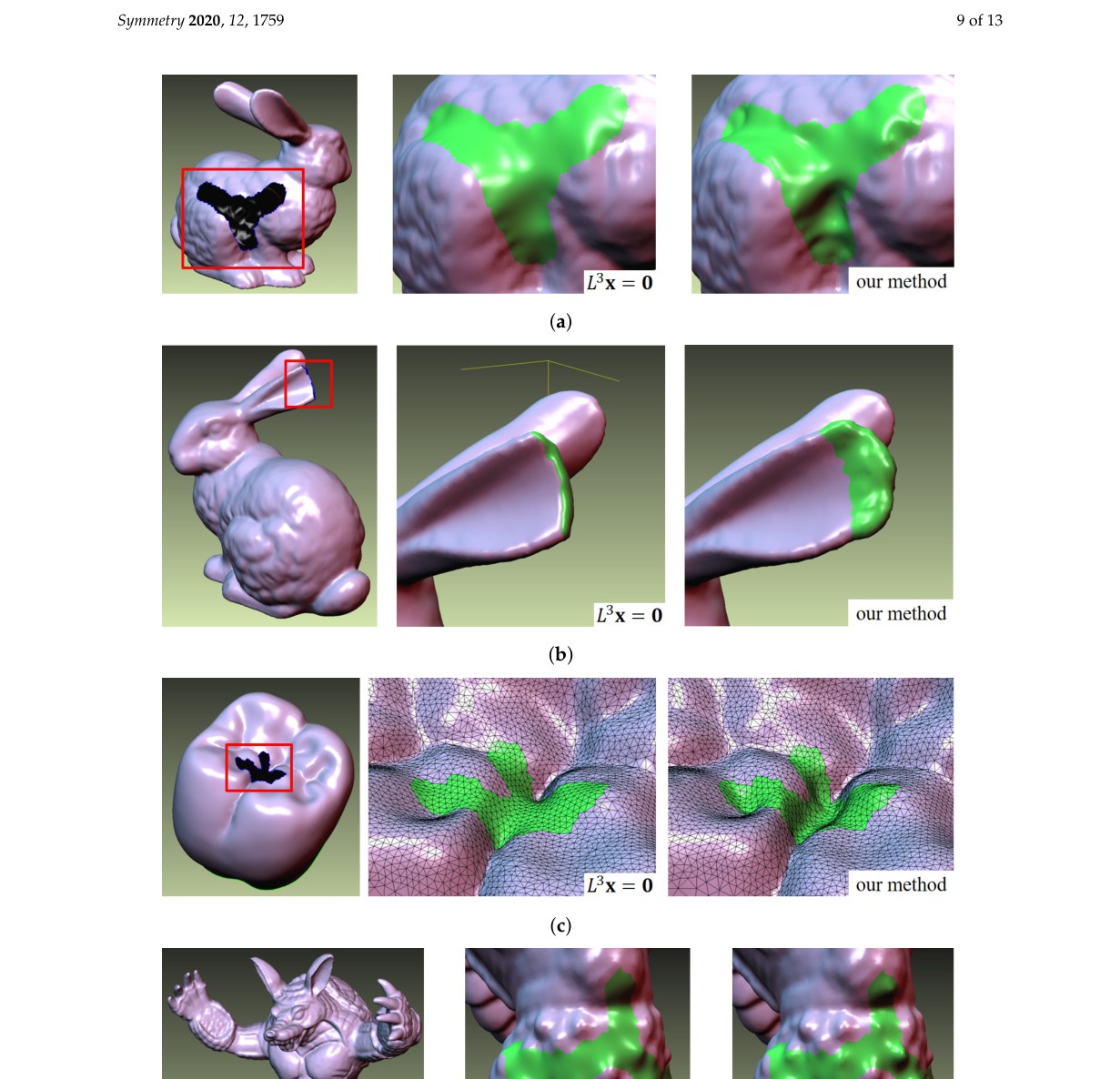
Parametric Blending of Hole Patches Based on Shape Difference
An effective technique for filling holes in triangular meshes by blending two patches based on shape difference. An initial patch is generated by iterative refinement, then enhanced into a target patch by minimizing principal curvature variation. A Laplacian-smoothed source patch is generated, and per-vertex blending weights are determined from the shape difference in terms of Euclidean distance and curvature variation, enabling faithful recovery of salient geometric features.
- "Efficient Minimum Distance Computation For Solid of Revolution," Computer Graphics Forum (SCIE, Special Issue in Eurographics), 39(2): 535–544, 2020.
[2019]
Computers & Graphics 2019, 81: 61–72 · Elsevier (SCIE)
Fast and Robust Computation of the Hausdorff Distance Between Triangle Mesh and Quad Mesh for Near-Zero Cases
An algorithm for computing the two-sided Hausdorff distance between a triangle mesh and a quad mesh, guaranteed within a given error bound down to machine precision. The algorithm extends a prior one-sided method by completing the opposite direction (quad-to-triangle) via splitting each quad into two triangles and introducing new matching methods. Experimental results demonstrate interactive-speed computation even for near-zero Hausdorff distance cases.
The Visual Computer 2019, 35(3) · Springer (SCIE)
Minkowski Sum Computation for Planar Freeform Geometric Models using G¹-Biarc Approximation and Interior Disk Culling
A robust and efficient Minkowski sum algorithm for planar freeform geometric models. Input boundary curves are approximated by G¹-biarc splines, enabling exact convolution arc computation. Interior disk culling trims redundant convolution arcs using a grid-based structure of interior disks, dramatically reducing the number of candidate arcs and improving overall efficiency compared to prior methods.
[2018]
Symmetry 2018, 10(11), 620 · MDPI (SCIE)
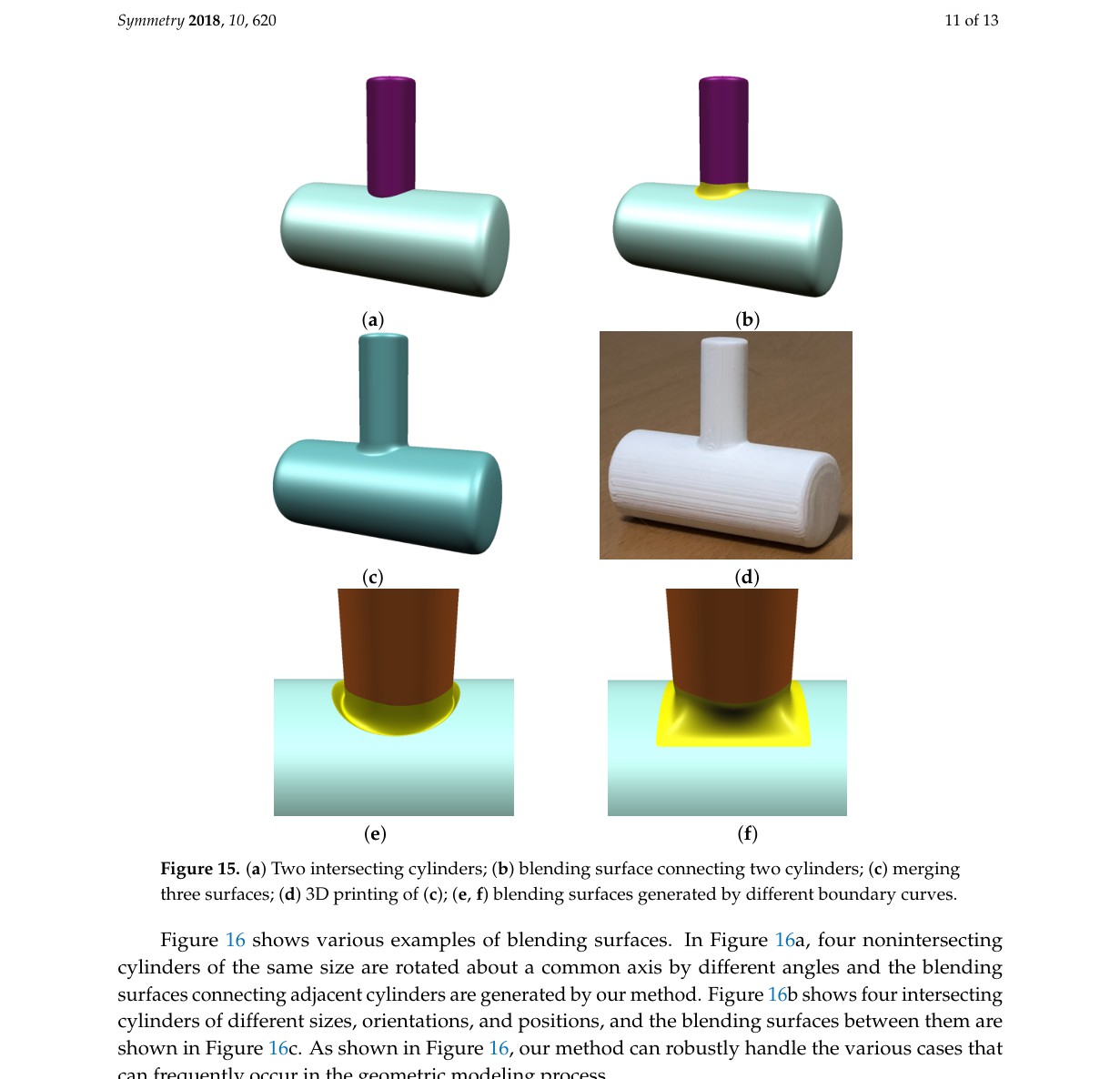
Parametric Blending of Triangular Meshes
A method for constructing a parametric blending surface that smoothly connects two triangular meshes. The user selects a subregion on each mesh; local parameterizations are found via geodesic polar coordinates and base surfaces are constructed from two boundary curves on the parametric domain. The two base surfaces are then smoothly blended, with shape controllable via parameters or direct surface-point manipulation.
Computer Aided Geometric Design 2018, 62: 91–103 · Elsevier (SCI) Best Paper Award
Fast and Robust Hausdorff Distance Computation from Triangle Mesh to Quad Mesh in Near-Zero Cases
An algorithm that computes the one-sided Hausdorff distance from a triangle mesh to a quad mesh with high robustness and low memory consumption. The algorithm avoids storing combinatorial pairs by using point projection via uniform grid, while achieving much higher precision than previous methods. Experimental results show that even near-zero Hausdorff distance cases are handled at interactive speed with manageable memory usage.
[2017]
Symmetry 2017, 9(12), 316 · MDPI (SCIE)
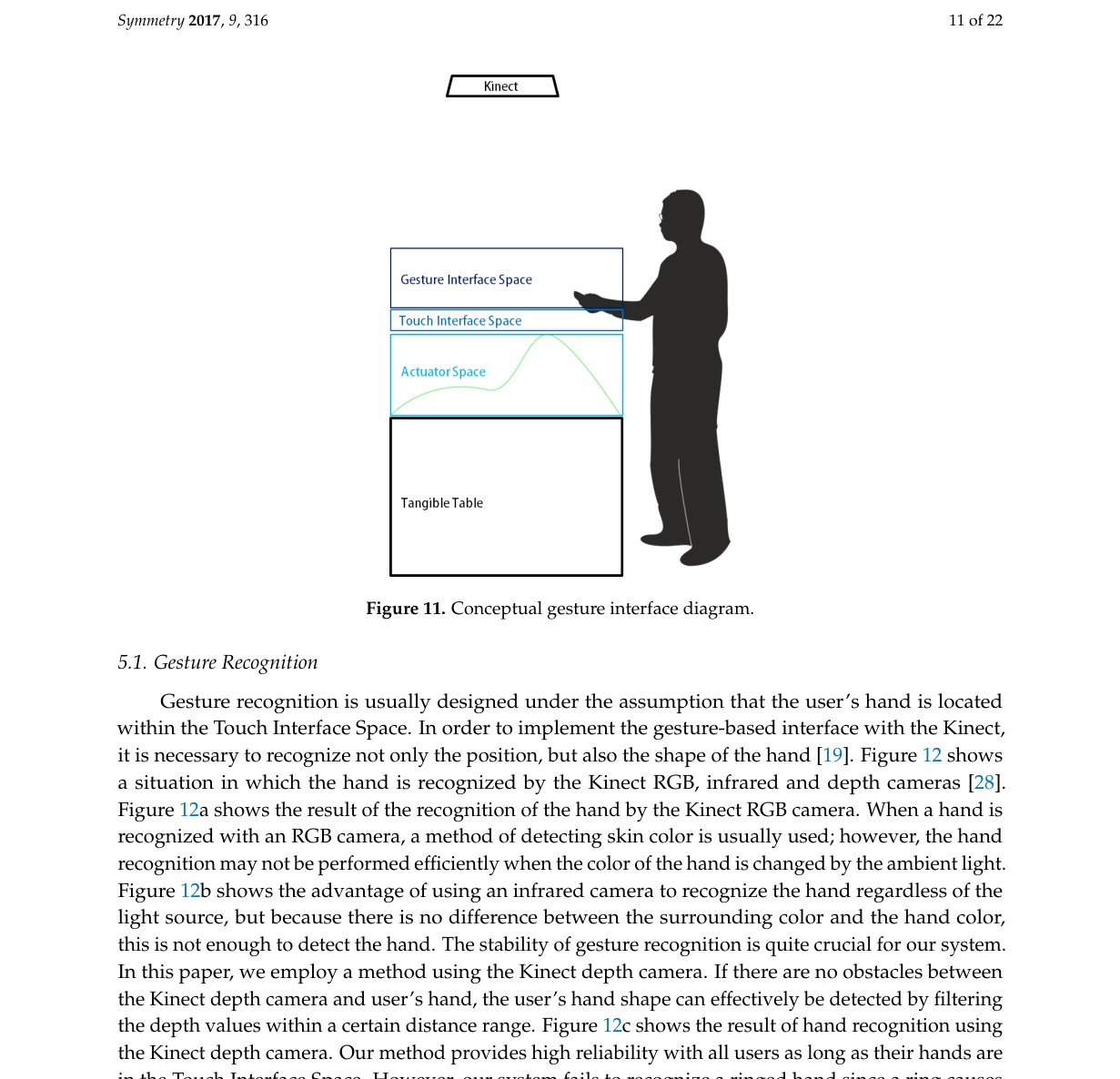
Tangible Visualization Table for Intuitive Data Display
We propose a new tangible visualization table for intuitive and effective visualization of terrain data transferred from a remote server in real time. The shape display approximating the height field of remote terrain data is generated by linear actuators, and the corresponding texture image is projected onto the shape display. To minimize projection distortions, we present a sophisticated technique for projection mapping. Gesture-based user interfaces facilitate intuitive manipulations of visualization results. We demonstrate the effectiveness of our system by displaying and manipulating various terrain data using gesture-based interfaces.
IEEE Computer Graphics and Applications 2017, 37(6): 65–75 · IEEE (SCI)
Blending Face Details: Synthesizing a Face Using Multiscale Face Models
We present a system for creating realistic 3D face models by blending multi-scale facial details. Our approach allows artists to intuitively design face models by parameterizing the problem in a way that is understandable and controllable. The system synthesizes faces by combining coarse shape with fine-scale details such as wrinkles and pores, leveraging multiscale displacement representations. This makes it possible to transfer and blend detailed facial features across different face models, enabling flexible and artist-friendly face design workflows for games and animated films.
[2016]
ETRI Journal 2016, 38(6): 1095–1103 · Wiley (SCI)
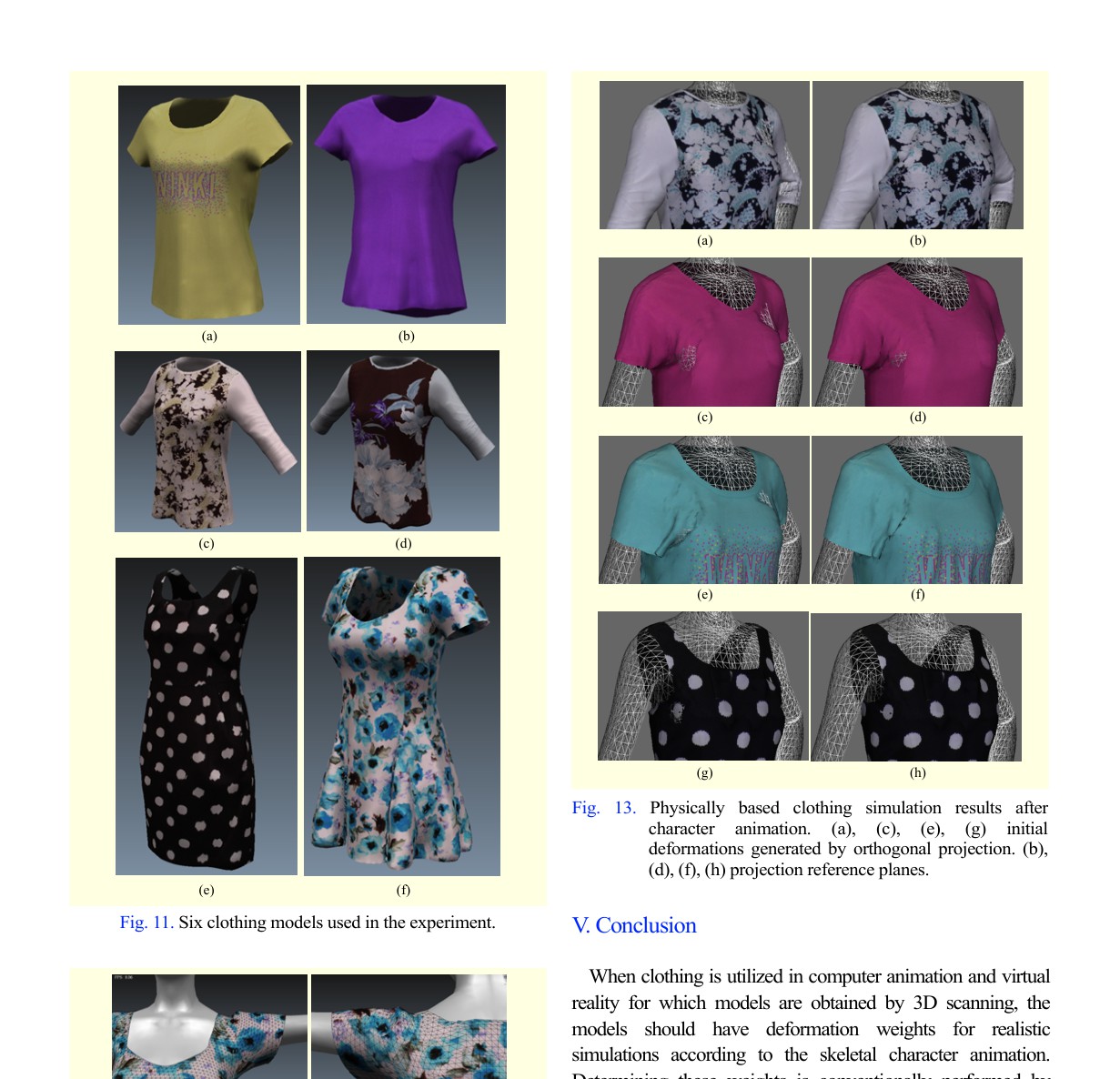
Transferring Skin Weights to 3D Scanned Clothes
We present a method for transferring deformation weights of a human character to three-dimensional (3D) scanned clothes. First, clothing vertices are projected onto a character skin. Their deformation weights are determined from the barycentric coordinates of the projection points. For more complicated parts, such as shoulders and armpits, continuously moving planes are constructed and employed as projection reference planes. Clothing vertices on a plane are projected onto the intersection curve of the plane with a character skin to achieve a smooth weight transfer. The proposed method produces an initial deformation for physically based clothing simulations.
Symmetry 2016, 8(11): 121 · MDPI (SCIE)
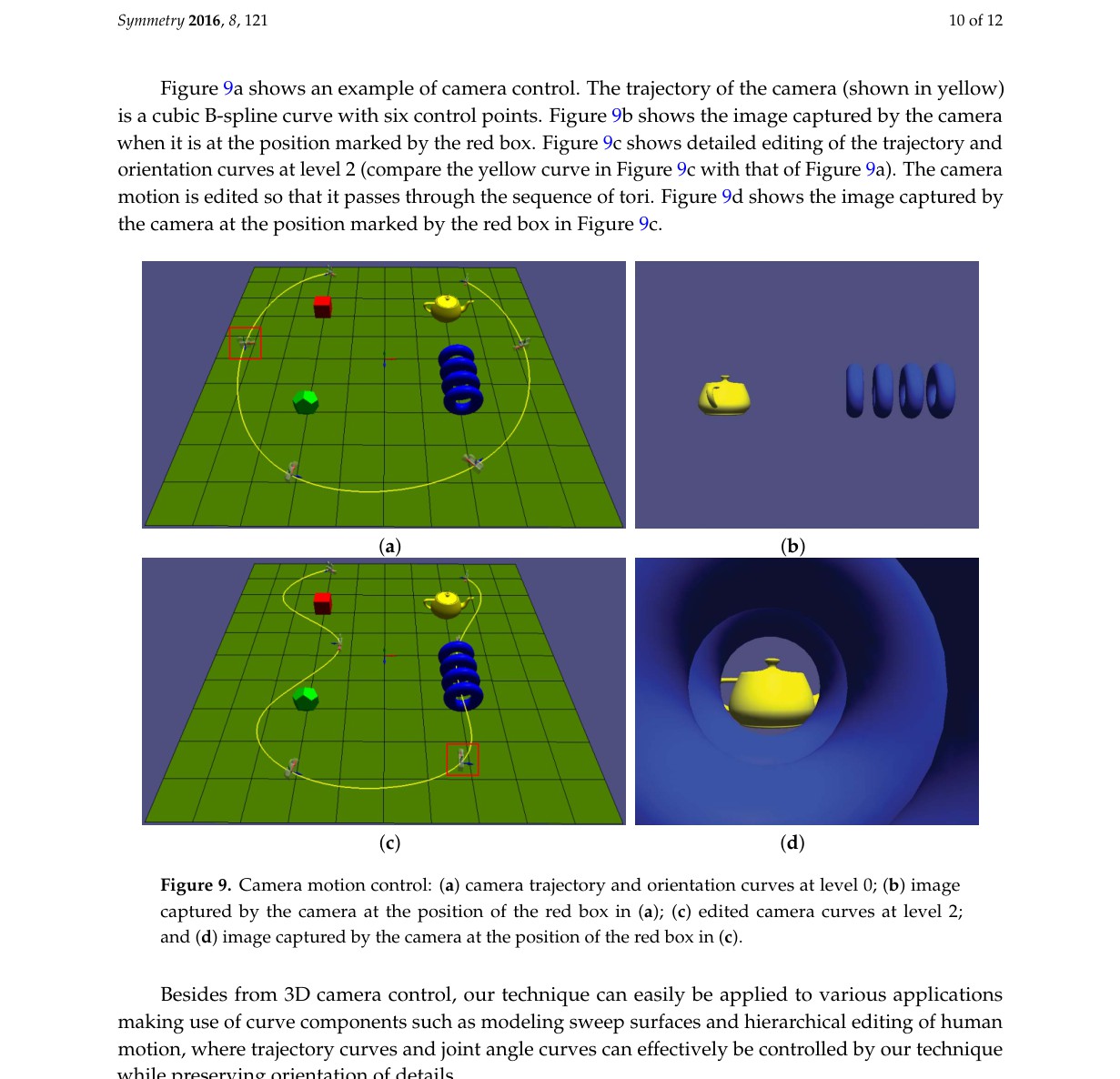
Multilevel Editing of B-Spline Curves with Robust Orientation of Details
We facilitate the editing of hierarchical B-spline curves at multiple resolutions by expressing a displacement function at each level in rotation minimizing frames (RMFs) on the curve at the next lower level. When the curve is edited at a particular level, RMFs at all the higher levels are updated, and the control points of the displacement function at each higher level are obtained from these new RMFs. This transfers details created at the current level to higher levels. Our method presents a hundred-fold faster way to reflect editing results compared to the traditional approach using Frenet frames.
Symmetry 2016, 8(7): 67 · MDPI (SCIE)
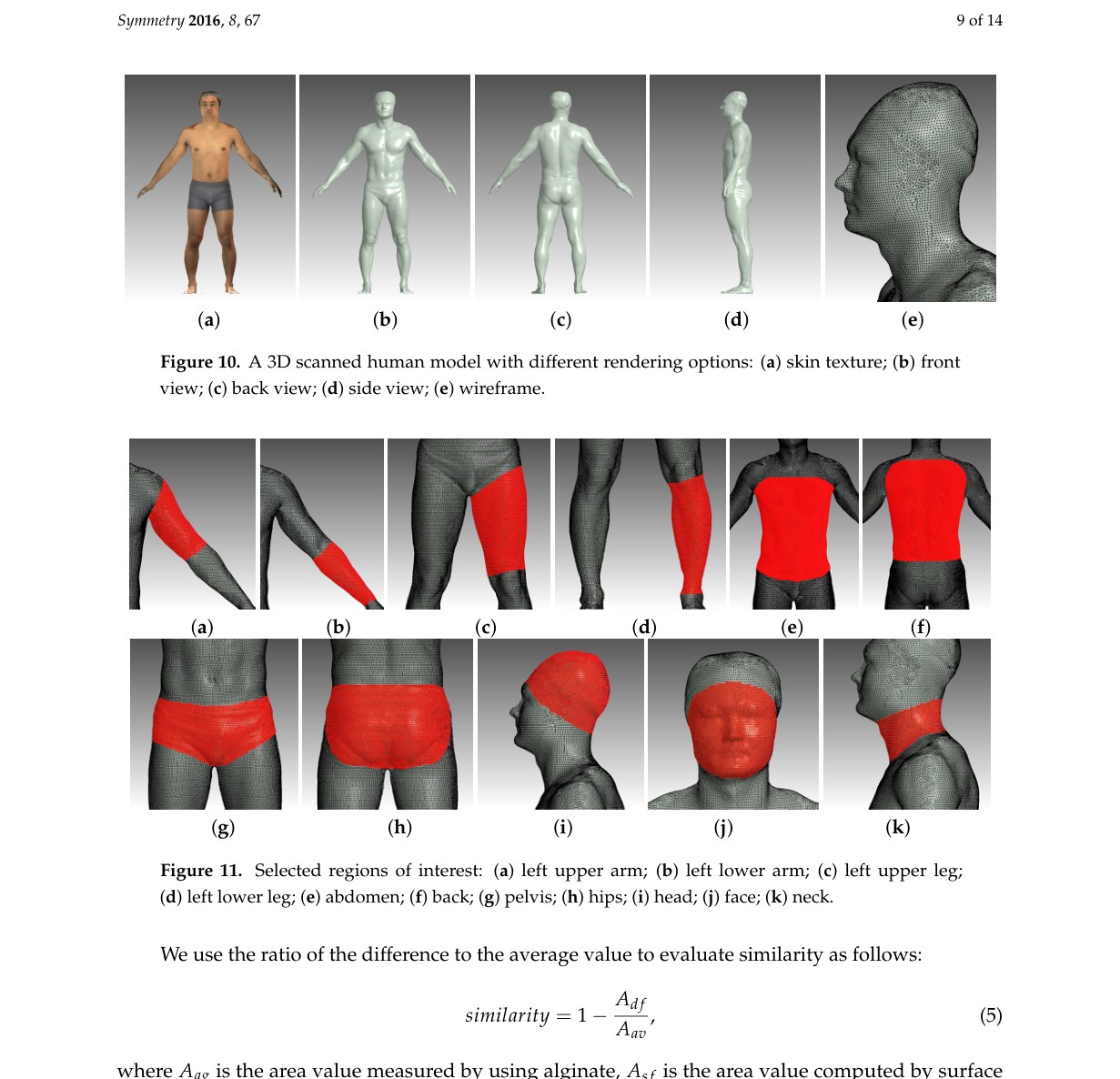
Computing the Surface Area of Three-Dimensional Scanned Human Data
An efficient surface area evaluation method is introduced by using smooth surface reconstruction for three-dimensional scanned human body data. Surface area evaluations for various body parts are compared with the results from the traditional alginate-based method, and quite high similarity between the two results is obtained. We expect that our surface area evaluation method can be an alternative to measuring surface area by the cumbersome alginate method.
Multimedia Tools and Applications 2016, 75(6): 3391–3407 · Springer (SCIE)
Video-Based Weathering Gallery
We present a simple and effective method for constructing a gallery that consists of weathering effect elements called time-dependent appearance manifolds (TDAMs). Since TDAMs are computed from sample video clips showing dynamic weathering phenomena, they represent very smooth changes in the appearance of weathered pixels over time. Once a gallery with a variety of weathering effects is prepared, users can interactively choose and apply the predefined effects onto the surface of 3D graphic models. This video-based weathering method supports predictable, intuitive, and natural effects, allowing users to produce photorealistic augmented videos.
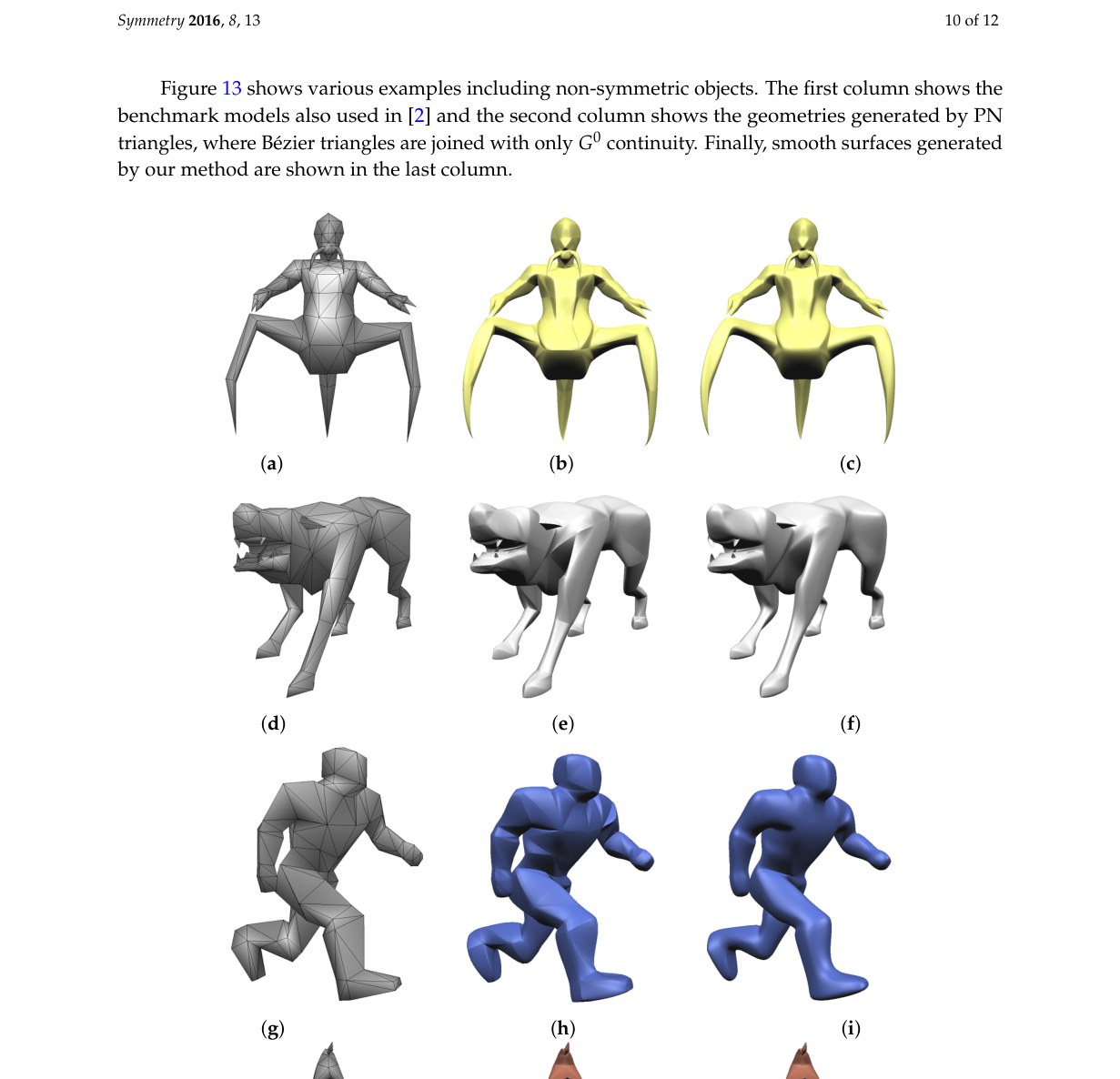
Symmetry 2016, 8(3): 13 · MDPI (SCIE)
Bézier Triangles with G² Continuity across Boundaries
PN (point-normal) triangles are cubic Bézier triangles which meet at their edges to surface a triangular mesh, but this only achieves G0 continuity. We define blending regions that span the edges shared by adjacent pairs of triangular domains and blend the corresponding Bézier triangles using a univariate blending function formulated in terms of barycentric coordinates. This produces G2 continuity across boundaries while preserving G1 continuity at vertices. The sharpness of the blends can be controlled locally by varying the extent of these blending regions.
[2015]
Computer-Aided Design 2015, 58(c): 230–235 · Elsevier (SCI)
Constructing Developable Surfaces by Wrapping Cones and Cylinders
We model developable surfaces by wrapping a planar figure around cones and cylinders. Complicated developables can be constructed by successive mappings using cones and cylinders of different sizes and shapes. We also propose an intuitive control mechanism, which allows a user to select an arbitrary point on the planar figure and move it to a new position. Numerical techniques are then used to find a cone or cylinder that produces the required mapping. Several examples demonstrate the effectiveness of our technique.
[2014]
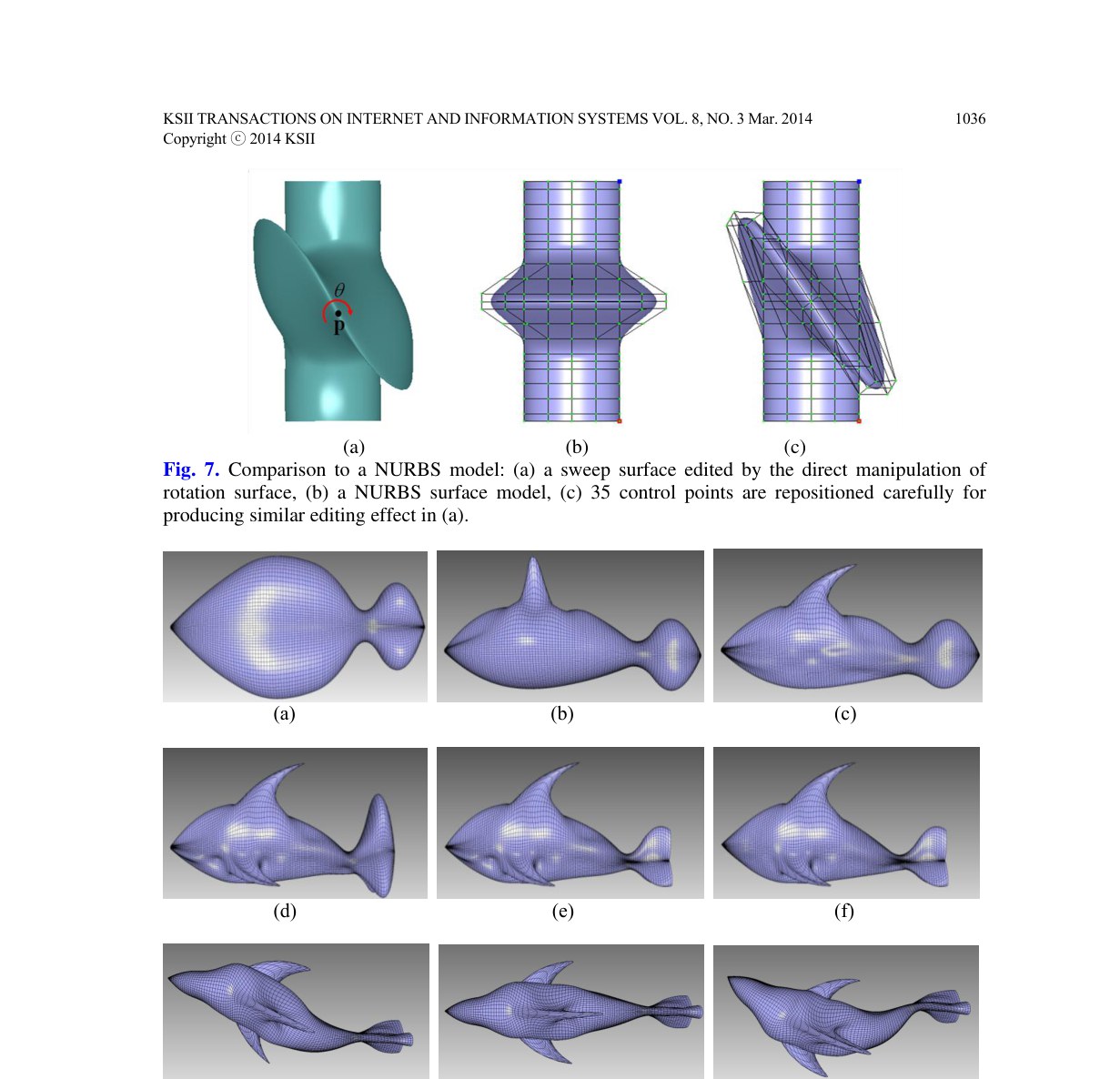
KSII Transactions on Internet and Information Systems 2014, 8(3): 1026–1036 · KSII (SCIE)
A Sweep Surface Based on Bivariate B-spline Motion
We present a new method for generating sweep surfaces using bivariate B-spline motion. The sweep surface is defined as the trace of a single point under bivariate B-spline motion. Direct manipulation of the sweep surface is achieved by controlling its motion components while producing various editing effects. We demonstrate the effectiveness of our technique by modeling and deforming various three-dimensional shapes.
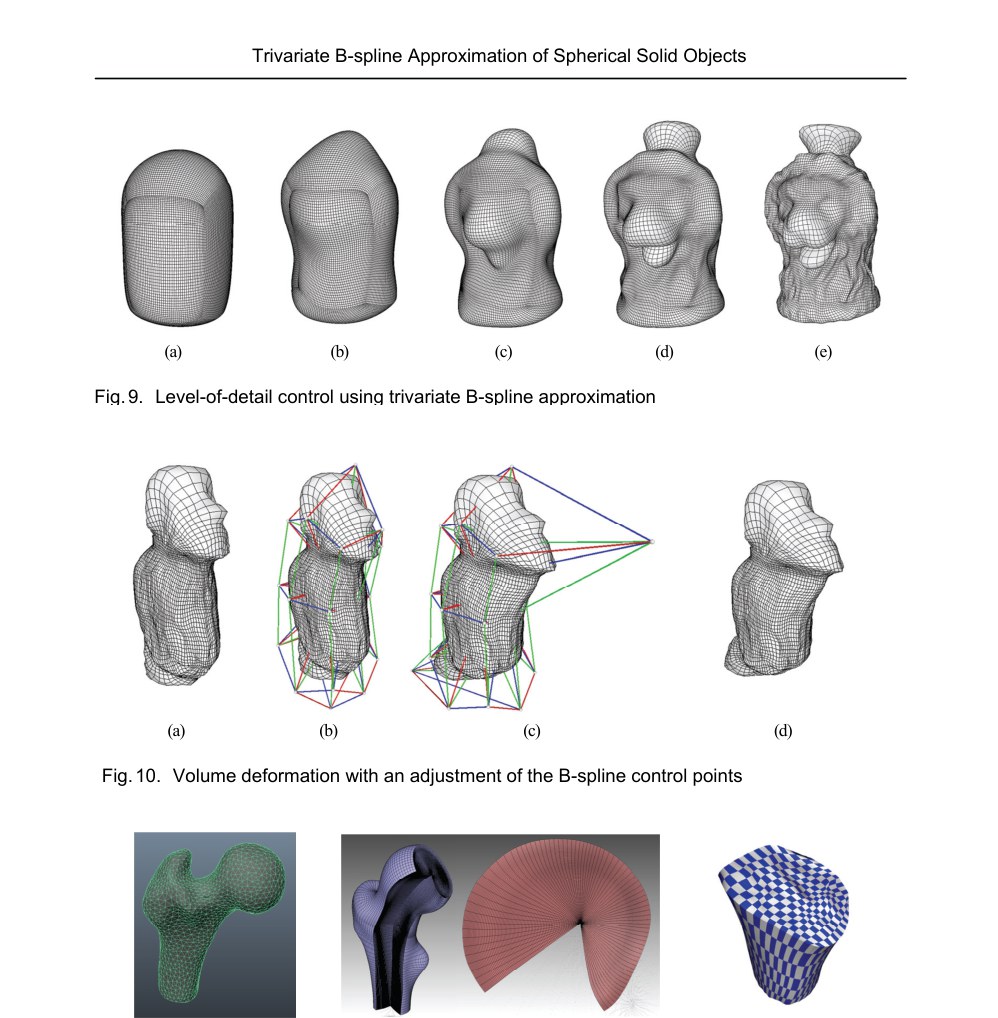
Journal of Information Processing Systems 2014, 10(1): 23–35 · KIPS (SCOPUS)
Trivariate B-spline Approximation of Spherical Solid Objects
We present an efficient framework for the shape approximations of spherical solid objects based on trivariate B-splines. We construct a smooth correspondence between a given object and a unit solid cube by computing their harmonic mapping, and utilize the mapping to approximate the given object with B-splines in a coarse-to-fine manner. Our framework provides user-controllability of shape approximations, based on the control of the boundary condition of the harmonic parameterization and the level of B-spline fitting.
[2013]
Computer-Aided Design 2013, 45(2): 270–276 · Elsevier (SCI)
Efficient Hausdorff Distance Computation for Freeform Geometric Models in Close Proximity
We present an interactive-speed algorithm for computing the Hausdorff Distance (HD) between two freeform geometric models represented with NURBS surfaces. The algorithm is based on an effective technique for matching a surface patch from one model to the corresponding nearby surface patch on the other model, employing a bounding volume hierarchy (BVH) of Coons patches. By comparing local HD upper bounds against a global HD lower bound, we eliminate the majority of redundant surface patches from further consideration.
[2011]
ACM Transactions on Graphics 2011, 30(6): Article 169 · ACM (SCI)
Coons BVH for Freeform Geometric Models
We present a bounding volume hierarchy (BVH) for freeform NURBS surfaces, using Coons patches and bilinear surfaces as the bounding volumes. The hierarchy provides an efficient approximation of NURBS surfaces within a given error bound. This BVH facilitates a wide range of geometric operations including collision detection, minimum distance computation, and Hausdorff distance computation for complex freeform models at interactive speeds.
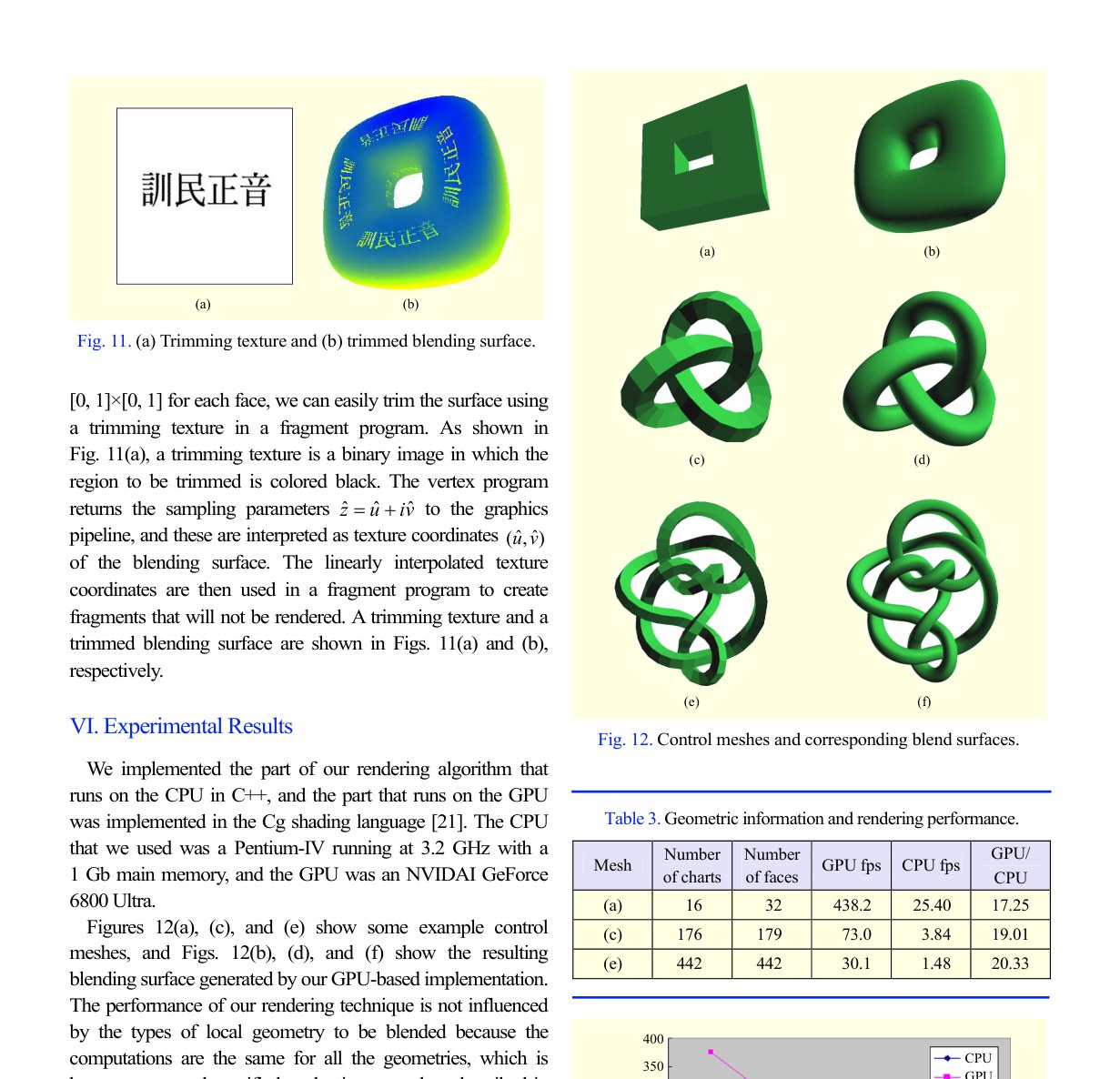
ETRI Journal 2011, 33(1): 89–98 · Wiley (SCI)
Construction and Rendering of Trimmed Blending Surfaces with Sharp Features on a GPU
We construct surfaces with darts, creases, and corners by blending different types of local geometries. We also render these surfaces efficiently using programmable graphics hardware. Points on the blending surface are evaluated using simplified computation which can easily be performed on a graphics processing unit. Results show an eighteen-fold to twenty-fold increase in rendering speed over a CPU version. We also demonstrate how these surfaces can be trimmed using textures.
[2005 – 2010]
The Visual Computer 2010, 26(6–8): 1007–1016 · Springer (SCIE)
Precise Hausdorff Distance Computation for Planar Freeform Curves using Biarcs and Depth Buffer
We present a real-time algorithm for computing the precise Hausdorff Distance between two planar freeform curves. The algorithm approximates each curve with a sequence of G1 biarcs within an arbitrary error bound. The distance map for the union of arcs is rendered efficiently to the graphics hardware depth buffer. By sampling the distance map along the other curve, we estimate a lower bound for the HD and eliminate many redundant curve segments, reducing computation to considerably smaller subproblems solved with a multivariate equation solver.
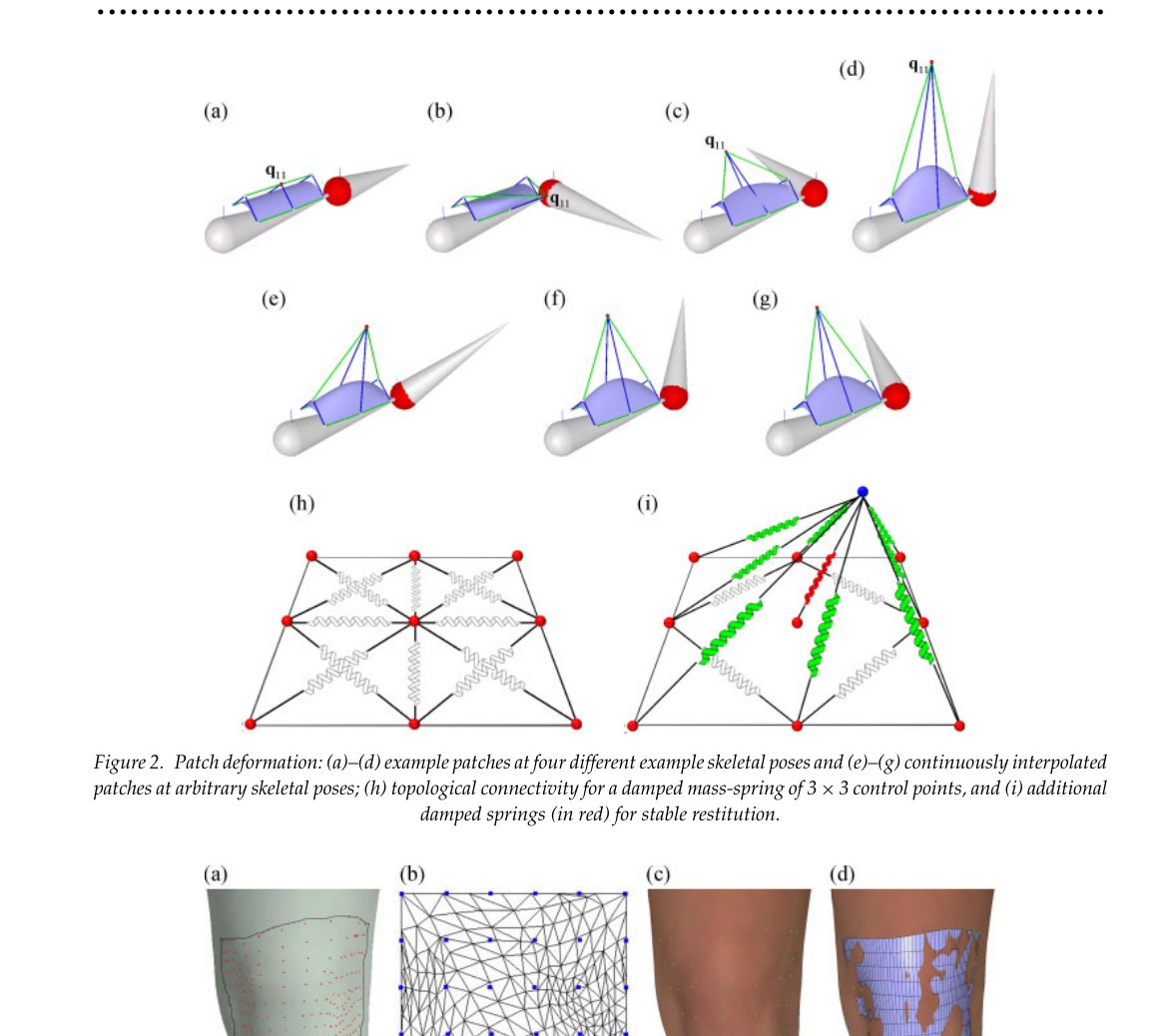
Computer Animation and Virtual Worlds 2009, 20(2–3): 321–331 · Wiley (SCI)
Patches: Character Skinning with Local Deformation Layer
We present a layered geometric approach to the skinning of character animation. On top of a global shape deformation, B-spline surface patches are attached to various body parts for local control. The patches are directly manipulated to generate example local shapes at important poses. During animation, B-spline control points interpolate a set of example patches kinematically while also moving dynamically by elastic simulation, generating natural local details including muscular effects at hundreds to thousands of frames per second.
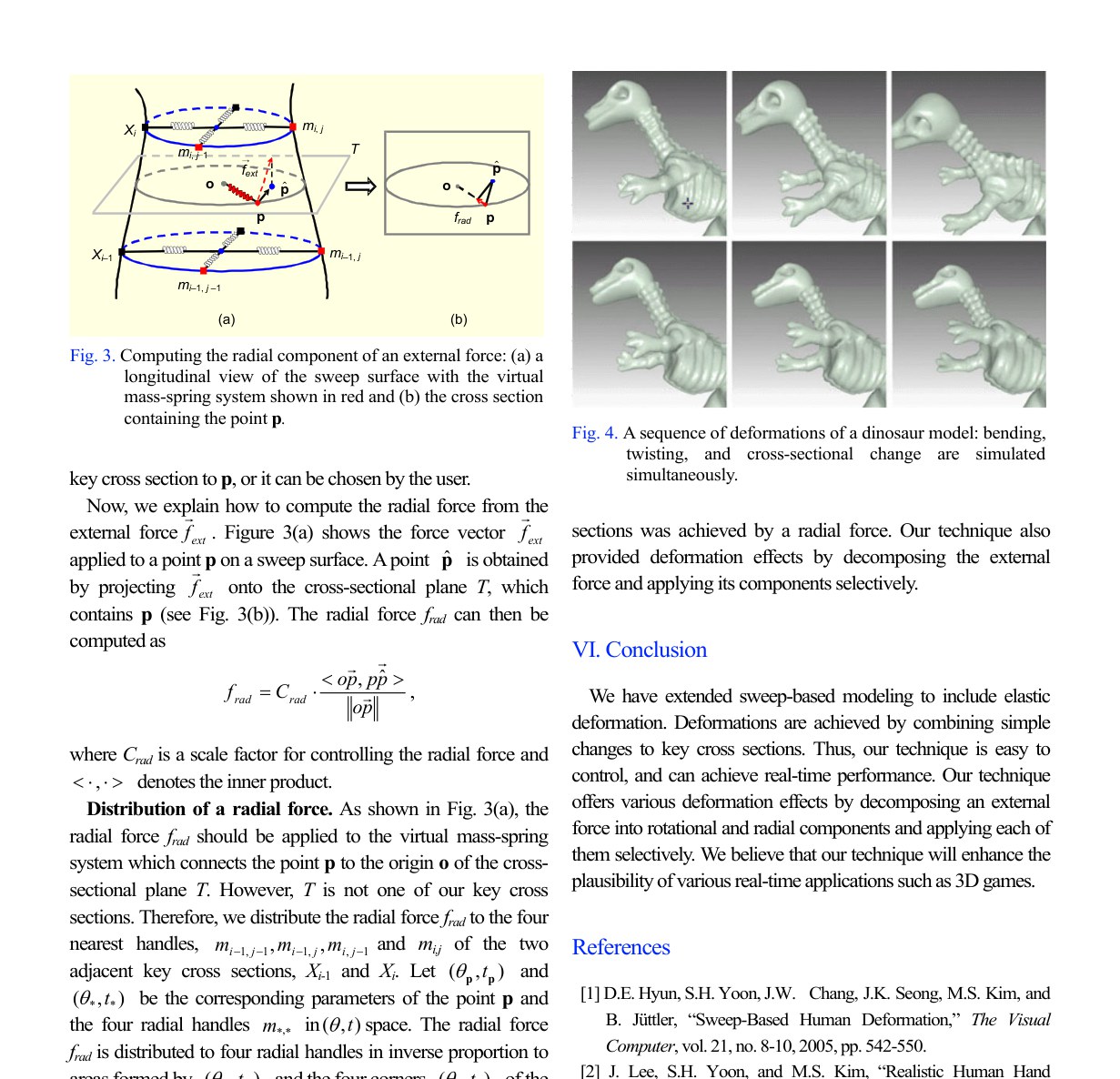
ETRI Journal 2008, 30(1): 152–154 · Wiley (SCI)
Sweep-based Plausible Elastic Deformations
We present a simple and efficient technique for plausible elastic deformation of three-dimensional objects. An elastic sweep surface is constructed by interpolating key cross sections with positions, orientations, and boundary shapes determined by physical simulation of simple mass-spring systems. The deformable parts of an object are approximated by elastic sweep surfaces, and the vertices of the deformable parts are bound to nearby sweep surfaces. As an external force is applied, the corresponding parts change their shapes elastically in real time.
Computer Graphics Forum 2006, 25(3): 487–496 · Wiley / Eurographics (SCIE)
Sweep-based Freeform Deformations
We propose a sweep-based approach to the freeform deformation of three-dimensional objects. Instead of using a volume enclosing the whole object, we approximate only its deformable parts using sweep surfaces. The vertices on the object boundary are bound to the sweep surfaces and follow their deformation. Several sweep surfaces can be organized into a hierarchy so that they interact with each other in a controlled manner, supporting intuitively plausible shape deformation of objects of arbitrary topology with multiple control handles, along with volume preservation.
The Visual Computer 2005, 21(8–10): 542–550 · Springer (SCIE)
Sweep-based Human Deformation
We present a sweep-based approach to human body modeling and deformation. A rigid 3D human model, given as a polygonal mesh, is approximated with control sweep surfaces. The vertices on the mesh are bound to nearby sweep surfaces and follow the deformation as the model bends and twists its arms, legs, spine and neck. Anatomical features including bone-protrusion, muscle-bulge, and skin-folding are supported by a GPU-based collision detection procedure. The volumes of arms, legs, and torso are kept constant using a volume integral formula for sweep surfaces.
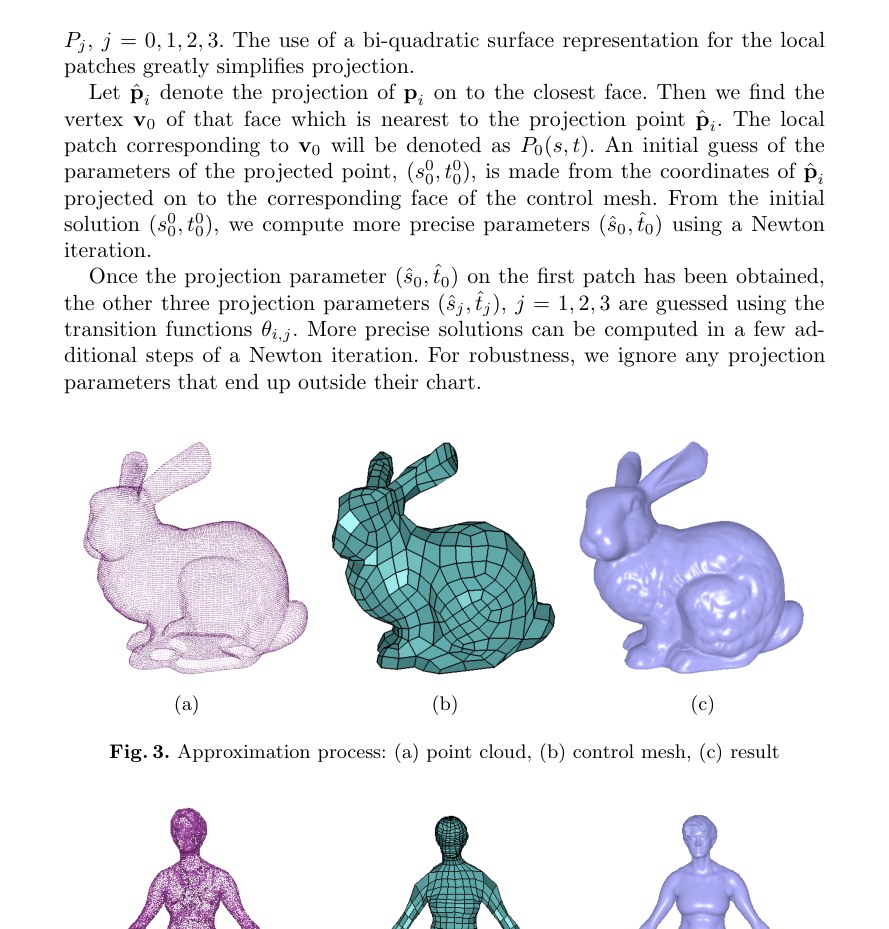
Lecture Notes in Computer Science 2006, 4077: 677–686 · Springer (SCIE)
A Surface Displaced from a Manifold
We present a new surface representation scheme based on a manifold structure and displacement functions. Given a geometric model represented as a point cloud, we construct a domain manifold which is a smooth surface blended from simple local patches. The original points are projected onto the local patches and their displacements are adjusted so that the final displaced surface approximates the given point data with high precision. Applications include multi-resolution representations and skeleton-driven shape deformation.
Computer Animation and Virtual Worlds 2006, 17(3–4): 479–489 · Wiley (SCI)
Realistic Human Hand Deformation
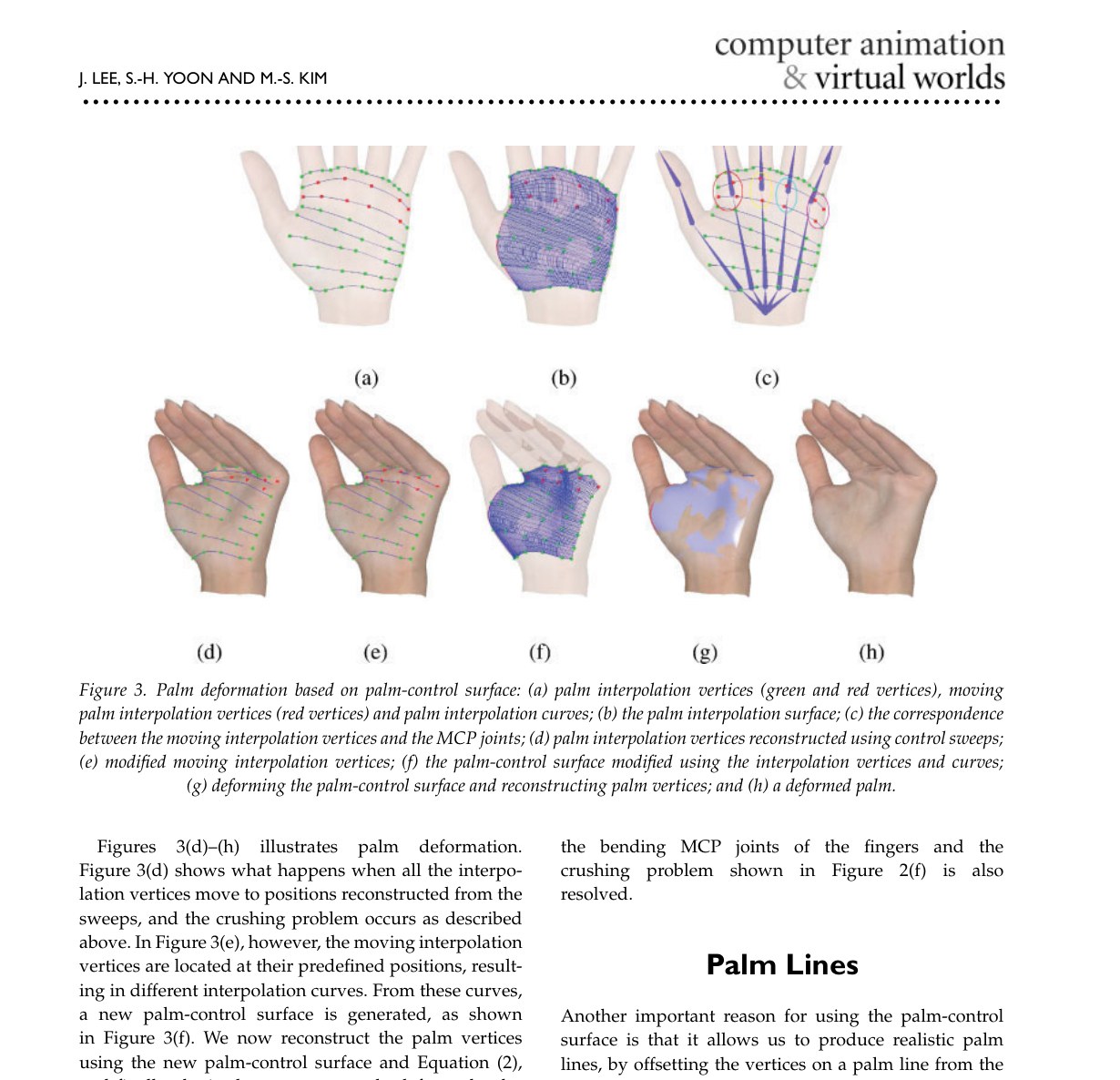
We present a new approach to realistic hand modeling and deformation with real-time performance. The underlying shape of a human hand is modeled by sweeps following a simplified skeleton. The resulting swept surfaces are blended, and an auxiliary palm-control surface handles bulges at various poses. Palm lines are modeled as valleys in a displacement map and activated by appropriate joint movements. Self-intersections and collisions are detected using geometric proximity tests.
- "Efficient Minimum Distance Computation For Solid of Revolution," Eurographics 2020, pp. 535–544, 2020.
- "XR Framework for Collaborating Remote Heterogeneous Devices," IEEE VR Workshop (VRW), pp. 587–588, Mar. 2020.
- "Fast and Robust Computation of the Hausdorff Distance Between Triangle Mesh and Quad Mesh for Near-Zero Cases," CAD and Graphics 2019, pp. 62–71, June 2019.
- "Minkowski Sum Computation for Planar Freeform Geometric Models using G1-Biarc Approximation and Interior Disk Culling," Computer Graphics International 2019, June 2019.
- "Fast and Robust Hausdorff Distance Computation from Triangle Mesh to Quad Mesh in Near-Zero Cases," Geometric Modeling and Processing (GMP) 2018, April 2018. Best Paper Award
- "Efficient Hausdorff Distance Computation for Freeform Geometric Models in Close Proximity," Symposium on Solid and Physical Modeling, 2012.
- "Coons BVH for Freeform Geometric Models," SIGGRAPH ASIA, Vol. 30, No. 6, Article 169, 2011.
- "Precise Hausdorff Distance Computation for Planar Freeform Curves using Biarcs and Depth Buffer," Computer Graphics International, pp. 1007–1016, June 2010.
- "Patches: Character Skinning with Local Deformation Layer," Computer Animation and Social Agents, pp. 321–331, June 2009.
- "Human Modeling and Deformation," China-Korea Joint Conference on Geometric and Visual Computing & IJCC Workshop 2008, pp. 89–96, Aug. 2008.
- "Realistic Human Hand Deformation," Geometric Modeling and Computer Graphics 2007, pp. 42–46, Feb. 2007.
- "A Surface Displaced From a Manifold," Geometric Modeling and Processing, pp. 677–686, July 2006.
- "Sweep-based Freeform Deformations," Eurographics, pp. 487–496, September 2006.
- "Realistic Human Hand Deformation," Computer Animation and Social Agents, pp. 479–489, July 2006.
- 정현석, 권성현, 김다혜, 윤승현, "메쉬 형상기반 3D 텍스트 생성 기법," 한국컴퓨터그래픽스학회논문지, 31(3): 11–20, 2025년 7월.
- 이승용, 이선호, 박준성, 신민철, 윤승현, "다중 피드백을 지원하는 몰입형 스마트 밸런스 보드," 한국컴퓨터그래픽스학회논문지, 30(3): 171–178, 2024년 7월.
- 왕문도, 이승용, 박상훈, 윤승현, "AR과 IoT 기술을 기반으로 한 건물 화재 모니터링 및 탈출 내비게이션 시스템," 한국컴퓨터그래픽스학회논문지, 30(3): 159–169, 2024년 7월.
- 김종용, 송종훈, 황규현, 윤승현, 박상훈, "확장현실 실감 콘텐츠 개발을 위한 AMR 볼륨 데이터 변환," 한국컴퓨터그래픽스학회논문지, 29(3): 105–115, 2023년 7월.
- 문지혜, 박상훈, 윤승현, "3D Magic Wand: 하모닉 필드를 이용한 메쉬 분할 기법," 한국컴퓨터그래픽스학회논문지, 28(1): 1–9, 2022년 3월.
- 박정호, 박상훈, 윤승현, "형상 차이 기반 홀패치의 파라미트릭 블렌딩 기법," 한국컴퓨터그래픽스학회논문지, 26(3): 39–48, 2020년 7월.
- 김종용, 박동근, 이필연, 조준영, 윤승현, 박상훈, "실감형 가상현실 실전 훈련 콘텐츠를 위한 관리 평가 시스템 개발 사례연구," 한국컴퓨터그래픽스학회논문지, 26(3): 111–121, 2020년 7월.
- 김종용, 송종훈, 박정호, 남재승, 윤승현, 박상훈, "빔 프로젝터를 이용한 혼합현실 확장 시스템: Beyond the Sight," 한국컴퓨터그래픽스학회논문지, 25(3): 65–73, 2019년 6월.
- 박정호, 김종용, 송종훈, 박상훈, 윤승현, "블렌드쉐입을 위한 다수 삼각 메쉬의 동시 단순화 기법," 한국컴퓨터그래픽스학회논문지, 25(3): 75–83, 2019년 6월.
- 신민철, 황해도, 윤승현, 이지은, "효과적인 뉴로피드백 훈련을 위한 임계값 설정 기법," 한국컴퓨터그래픽스학회논문지, 25(2): 19–29, 2019년 6월.
- 강윤구, 윤승현, 경민호, 김명수, "삼각형 메시와 사각형 메시 사이의 영에 가까운 하우스도르프 거리 계산," 한국정보과학회논문지, 46(2): 116–121, 2019년 2월.
- 김은지, 윤승현, 이지은, "GPU를 이용한 특징 기반 영상모핑의 가속화," 한국컴퓨터그래픽스학회논문지, 20(2): 13–24, 2014년 6월.
- 오종석, 윤승현, "하우스도르프 거리를 이용한 B-spline 곡선의 낫 제거," 한국컴퓨터그래픽스학회논문지, 17(3): 33–42, 2011년 9월.
- 윤승현, 이지은, "2-변수 모션 기반의 스윕곡면," 한국컴퓨터그래픽스학회논문지, 17(1): 1–7, 2011년 2월.
- 고대현, 윤승현, 이지은, "그래픽스 하드웨어를 이용한 스윕 곡면의 렌더링," 한국컴퓨터그래픽스학회논문지, 16(4): 11–16, 2010년 12월.
- 장츠, 윤승현, 이지은, "RMF를 이용한 계층적 B-spline 곡선의 다단계 편집기법," 한국컴퓨터그래픽스학회논문지, 16(4): 41–50, 2010년 12월.
- 윤승현, 김명수, "다양체 기반의 변위 곡면," 한국컴퓨터그래픽스학회논문지, 12(1): 1–7, 2006년 11월.
- 이지은, 윤승현, 김명수, "스플라인을 이용한 인체 손 형상 변형," 한국컴퓨터그래픽스학회논문지, 11(3): 1–9, 2005년 9월.
- 윤승현, 김명수, "스윕기반 자유형상변형," 한국컴퓨터그래픽스학회논문지, 11(2): 40–46, 2005년 6월.
- 윤승현, 현대은, 김명수, "3차원 인체치수 측정과 형상변형 기술," 패션정보와 기술, 1(1): 45–54, 2004년 11월.
- 현대은, 윤승현, 성준경, 장정우, 김명수, Bert Jüttler, "스윕 기반 인체 형상 모델링 및 변형," 한국컴퓨터그래픽스학회논문지, 10(2): 27–34, 2004년 6월.
- 현대은, 윤승현, 김명수, "3차원 스캔 데이터로부터의 인체 팔, 다리 형상 복원," 한국컴퓨터그래픽스학회논문지, 8(4): 1–7, 2002년 12월.
- 왕문도, 이승용, 박상훈, 윤승현, "실내 화재재난 대응을 위한 AR 내비게이션," 한국컴퓨터그래픽스학회논문지(학술대회), 2022년.
- 김종용, 송종훈, 윤승현, "확장현실 실감 콘텐츠 개발을 위한 AMR 볼륨 데이터 변환," 한국컴퓨터그래픽스학회논문지(학술대회), 2022년.
- 이선호, 윤승현, 이지은, 박상훈, "Geodesy 기반의 메쉬 위에서의 자동 경계박스 생성 및 스케치기반 탐색 기법," 한국컴퓨터그래픽스학회 학술대회, pp. 1421–1423, 2018년. Best Paper Award
- 황해도, 윤승현, 이지은, 신민철, 이선호, "뇌파기반 뉴로피드백 훈련을 위한 심각한 비디오게임 콘텐츠 개발에 대한 연구," 한국컴퓨터그래픽스학회 학술대회, pp. 71–72, 2011년 7월.
- 황해도, 윤승현, 이지은, 고대현, 장츠, "스윕 곡면의 내부 Hausdorff 거리," 한국컴퓨터그래픽스학회 학술대회, pp. 205–206, 2010년 6월.
- 고대현, 윤승현, 이지은, "3차원 스캐닝을 이용한 효과적인 리메쉬 모델 제작 및 렌더링에 관한 연구," 한국HCI학회 학술대회, pp. 257–226, 2009년 4월.
- "Sweep-based Approach to Three-Dimensional Shape Deformations," Verlag Dr. Müller, May 2008.